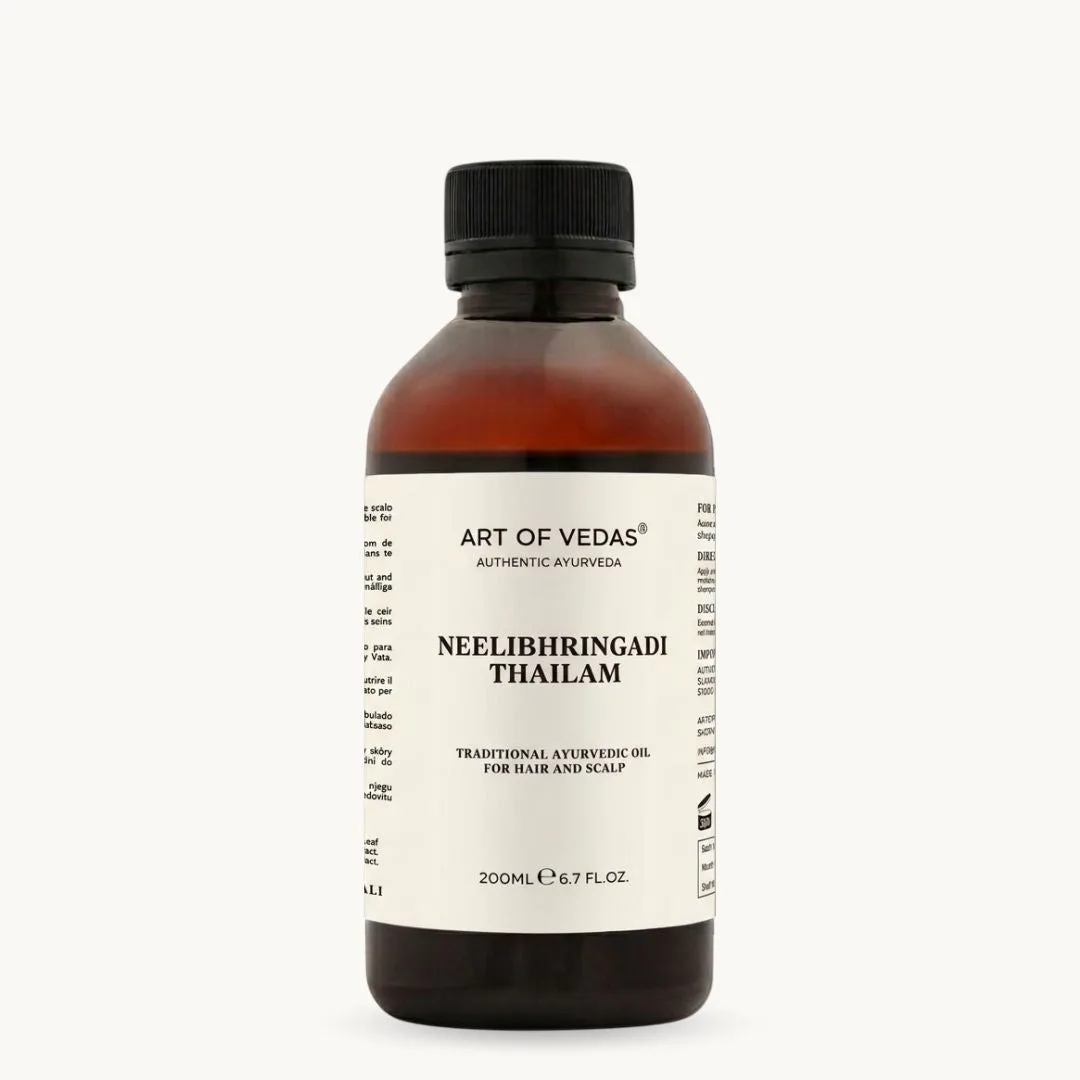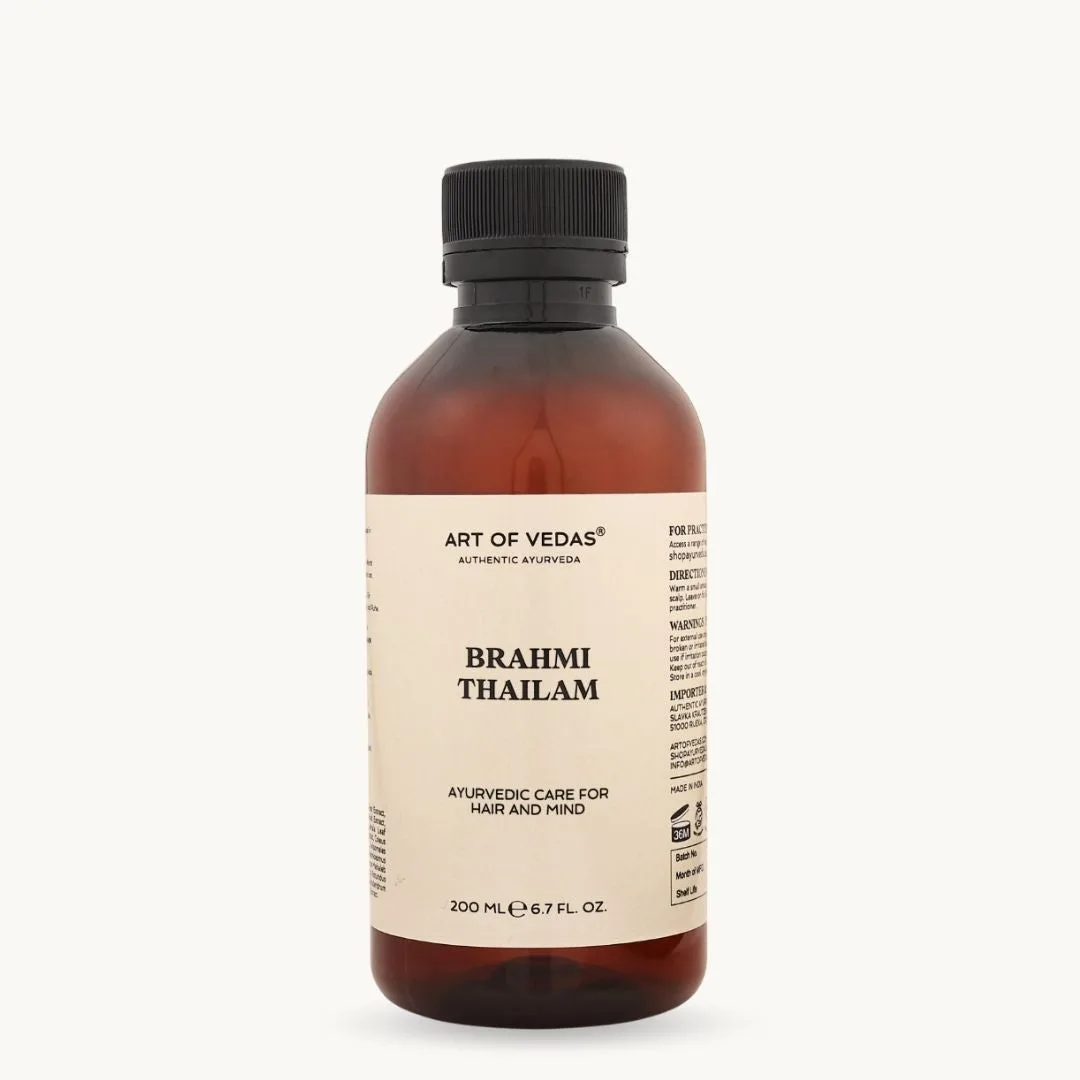
In brief: Bhringamalakadi Thailam (also written Bhringamalakadi Thailam, Bhringamalakadi Taila or Bhringamalakadi oil) is a classical Ayurvedic medicated oil named after its two leading plants, Bhringaraja, Eclipta alba, and Amalaki, Emblica officinalis. The Sahasrayogam lists it among its oils, and the tradition describes it as cooling, placed with Pitta, and used for Shiroabhyanga, the oil massage of the head and scalp. Art of Vedas does not currently offer Bhringamalakadi Thailam; the closest oils in our range are Neelibhringadi Thailam and Brahmi Thailam. This guide covers what it is, how the texts describe it, how a head oil is used, and which of our oils come nearest.
What Bhringamalakadi Thailam is and where the name comes from
The name is a compound of three parts. Bhringa is short for Bhringaraja, Eclipta alba, a small plant of damp ground whose leaves are one of the classical materials of the head oils; Amalaka is Amalaki, Emblica officinalis, the sour fruit better known in Europe as Amla; and the suffix adi means "beginning with". Bhringamalakadi Thailam is therefore the oil whose recipe begins with Bhringaraja and Amalaki. Thailam, Thailam and Taila are the same word in different transliterations and mean a medicated oil, a base oil into which juices, decoctions and a paste of plants have been cooked until the water has gone. It belongs to the group of oils the texts reserve for the head.
The classical description
The classical recipe names, among others, the juice of Bhringaraja and the juice or decoction of Amalaki, with Yashtimadhu, the liquorice root, in the paste, cooked into a sesame oil base by the Sneha Paka method. Some versions add further liquids to the cooking and some makers use a different base oil, so the exact composition depends on which text a maker follows. The Sahasrayogam, the collection of recipes used in the southern tradition, lists a Bhringamalakadi Thailam in its section on oils. Where the texts describe it, they do so in the language of the head and of Pitta, and this guide adds no claims of its own.
Character in Ayurvedic terms
The tradition describes Bhringamalakadi Thailam as cooling, Sheeta, and places it with Pitta, with Vata second. Bhringaraja and Amalaki are both read in the materia medica as cooling plants of the head, and Yashtimadhu as sweet and cooling; cooked into the oil in quantity they set its character, while the sesame base serves as the carrier. This places it in the same family as Neelibhringadi Thailam in the Art of Vedas range, which shares Bhringaraja and Amalaki as declared ingredients.
How a head oil is used in practice
Bhringamalakadi Thailam is an oil of Shiroabhyanga, the oil massage of the head and scalp, which the classical daily routine, Dinacharya, lists alongside the massage of the body. Take a small amount at room temperature, or very slightly warmed, and work it into the scalp with the fingertips in small circles, from the crown outwards, then along the hairline and the back of the head. Leave it on for 20 to 30 minutes and wash it out with a mild hair wash. Once or twice a week is the usual rhythm; a cooling oil suits the evening and the warmer months. This guide describes the practice only; what an oil does for the hair over time is not something Art of Vedas claims. Our Abhyanga guide describes the full routine.
Who should ask first
Medicated oils of this kind are for external use only. Do a small skin test on the inner forearm before the first full application, and keep the oil away from the eyes. In pregnancy, and before using any oil on a child, ask your doctor or a qualified Ayurvedic practitioner first. A qualified Ayurvedic practitioner is also the right person to ask whether a cooling head oil suits you.
Art of Vedas and Bhringamalakadi Thailam
Art of Vedas does not currently offer Bhringamalakadi Thailam. The closest oils in our range are Neelibhringadi Thailam, a classical head oil that declares Bhringaraja, Amalaki and indigo leaf among its ingredients and is the nearer of the two in composition, and Brahmi Thailam, a Brahmi-led oil in a sesame base used for Shiroabhyanga and described as cooling. For every classical oil we carry and how to choose between them, see our complete guide to traditional Ayurvedic Thailams.