Choosing an Ashwagandha product comes down to four decisions: whether the material is the root or the whole plant, whether you want a loose powder or capsules, whether you are buying whole root or a concentrated extract, and what testing the supplier is able to show you. Get those four right and the rest is preference.
Ashwagandha is the root of Withania somnifera, described in the classical Ayurvedic texts as a Rasayana and traditionally taken in the evening. Products on the European market vary a good deal, so it is worth knowing what a label is actually telling you.
1. Root, not whole plant
Classical Ayurvedic use of Ashwagandha is use of the root. Leaves and aerial parts have a different composition and are not what the traditional literature describes. A good label states the plant part explicitly, as root or radix. If a label names only Ashwagandha with no plant part given, or says whole plant or aerial parts, it is not the classical material. This is the single most useful thing to check.
2. Powder or capsule
Powder, the Churnam
The classical form is Churnam, a fine dried powder. Powder lets you adjust the quantity, it is the least processed option, and it is what a practitioner will usually suggest. The drawback is the taste, which is strongly bitter, and the smell, which is reminiscent of a horse, as the Sanskrit name says directly. Our Ashwagandha powder is a plain single-herb Churnam.
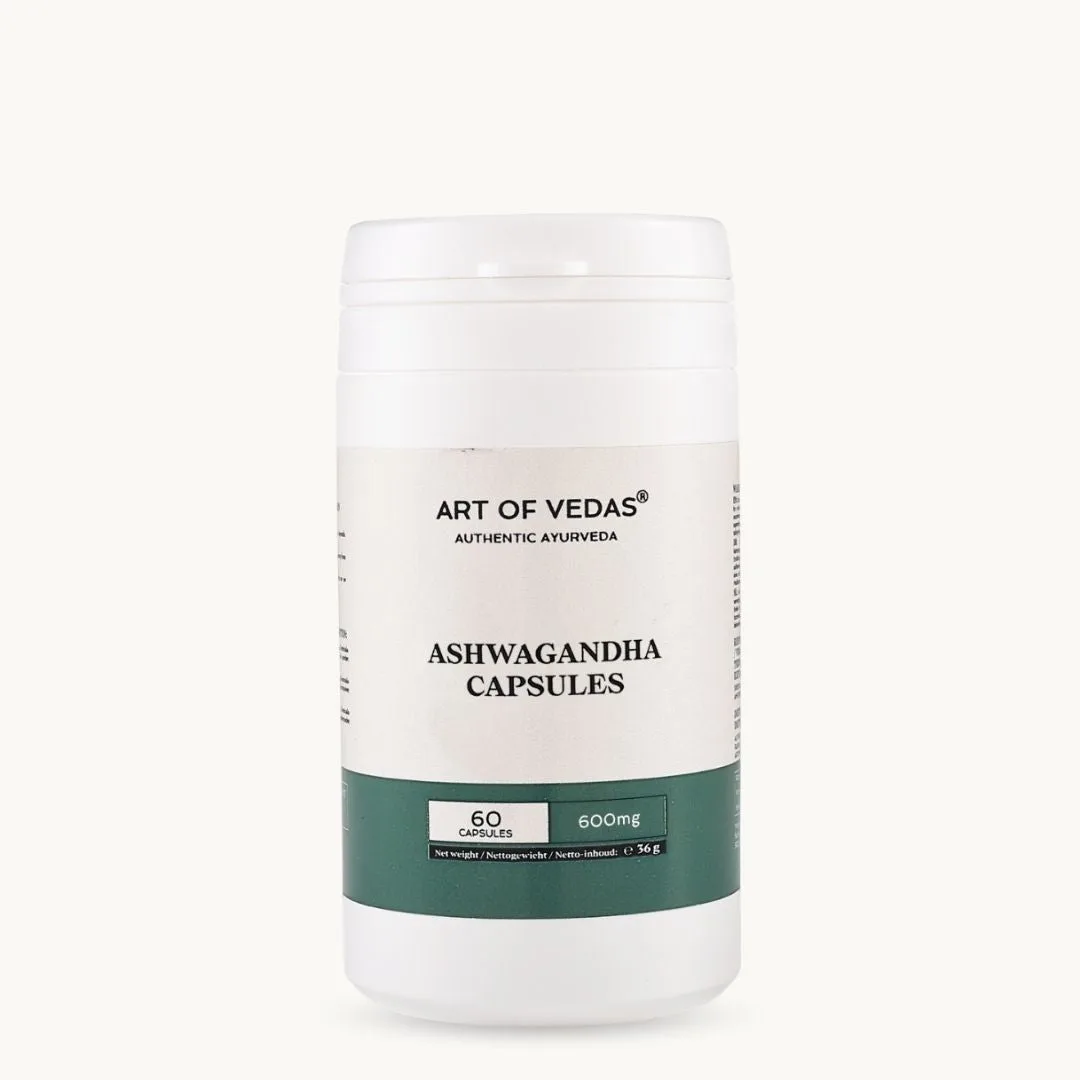
Capsules
Capsules hold the same powder in a measured amount inside a vegetarian shell. They remove the taste, they travel well, and they make a daily routine easy to keep. They are correspondingly less flexible in quantity. Our Ashwagandha capsules are made for that use. The general trade-offs between the forms are set out in our comparison of Churnam, Vati and capsules.
3. Whole root or standardised extract
Two quite different things are sold under one name.
- Whole root powder is the dried root, ground. It is the classical material, and the whole of what the traditional texts describe.
- Standardised extract is root material concentrated with a solvent and adjusted to a stated percentage of withanolides. It is a modern preparation in a pharmaceutical style, not a classical one.
Neither is inherently the better choice. If your interest is classical Ayurvedic practice, whole root powder is the correct material, and the quantity taken is correspondingly larger. If you are following a protocol written around a standardised extract, whole root powder is not an equivalent substitute weight for weight. What matters is that the label makes clear which of the two you are buying, and that an extract states its extraction ratio and its solvent.
4. Sourcing and testing
Herbal raw material is an agricultural product, so the questions worth asking a supplier are the ordinary ones.
- Is the botanical name Withania somnifera stated, together with the plant part?
- Is there batch testing for heavy metals, pesticide residues and microbiological quality?
- Will the seller provide a certificate of analysis for the batch you are buying?
- Is there a lot number and a best-before date printed on the pack?
- Does the ingredient list contain only what you want, without bulking agents or flow agents you did not ask for?
A seller who cannot answer these questions is not a seller to buy an ingested product from. Note also that the regulatory position of Ashwagandha food supplements is not identical in every EU member state, so availability differs by country.
How Ashwagandha is traditionally taken
In classical practice Ashwagandha is taken as a Churnam stirred into a small quantity of warm water or a warm plant-based drink, most often in the evening. It sits within the Rasayana category, which concerns sustained regular use across a period rather than occasional use, and this is why practitioners speak of taking it in courses. Our classical guide to Ashwagandha covers the traditional context.
Follow the quantity stated on the product label, and do not exceed it on the assumption that more is better. That is not how Rasayana preparations are described in the texts, and a qualified practitioner is the right person to advise on regular use.
Frequently Asked Questions
Which part of the plant should Ashwagandha come from? The root, since classical Ayurvedic use is root use, and the plant part should be stated clearly on the label.
Is Ashwagandha powder or capsules better? Powder is the classical form and lets you adjust the quantity, while capsules give a measured amount and avoid the strong bitter taste.
What is the difference between whole root and a standardised extract? Whole root powder is simply the ground dried root, while a standardised extract is concentrated with a solvent to a stated withanolide percentage and is a modern rather than a classical preparation.
What should I check on an Ashwagandha label? The botanical name Withania somnifera, the plant part, the lot number, the quantity per serving and a short, clean ingredient list.
When is Ashwagandha traditionally taken? Classically it is taken in the evening, as a Churnam stirred into a little warm water or a warm plant-based drink.
Why does Ashwagandha have such a strong smell? The Sanskrit name refers to the smell of a horse, so the characteristic odour of the root is exactly what the name describes.
This article is provided for general information about traditional Ayurvedic practice and is not medical advice. Food supplements are not a substitute for a varied and balanced diet or a healthy lifestyle. Consult a qualified practitioner before use, particularly if you are pregnant, nursing or taking medication.