Important Disclaimer: Both Eladi Thailam and Kumkumadi Thailam are traditional Ayurvedic wellness oils for external use only. Neither treats, cures, or prevents any disease or medical condition. All descriptions are traditional Ayurvedic indications. For any skin condition requiring medical attention, please consult a qualified healthcare professional.
If you have been researching traditional Ayurvedic face oils, you have almost certainly encountered both names. Both are classical Ayurvedic formulations with centuries of history. Both use saffron as a key ingredient. Both are prepared in sesame oil using traditional Sneha Paka Vidhi methods. And both are marketed, often in identical language, as premium Ayurvedic facial oils for radiant, glowing skin.
So what actually separates them? And more importantly - which one is right for your skin?
This article gives you an honest, detailed comparison. Not a marketing exercise. We look at both formulas as they exist in classical Ayurvedic texts, what each contains and why, which skin types each is best suited to, and how the two work as part of a broader Ayurvedic skincare ritual. By the end, you will have a clear answer - even if that answer turns out to be: use both, in different ways.
The Short Answer
Eladi Thailam is a broad-spectrum traditional Ayurvedic facial oil - a complex, 25+ herb formula that balances warming and cooling ingredients, supports skin clarity, calms reactive skin, and is suitable for daily use across most skin types. Named after cardamom (Ela), its profile is aromatic, well-rounded, and genuinely multi-purpose.
Kumkumadi Thailam is the classical saffron face oil: a formula of the Varnya (complexion) tradition, named after saffron (Kumkuma), and used in a few drops on the face in the evening.
In short: Eladi is often used as the daily face oil, Kumkumadi as the evening face oil, and many people use both.
The Classical Origins: What the Texts Actually Say
Kumkumadi Thailam in Classical Texts
Kumkumadi Thailam is a classical Ayurvedic formula of the Varnya (complexion) tradition, with saffron (Kumkuma, Crocus sativus) as its leading and defining ingredient.
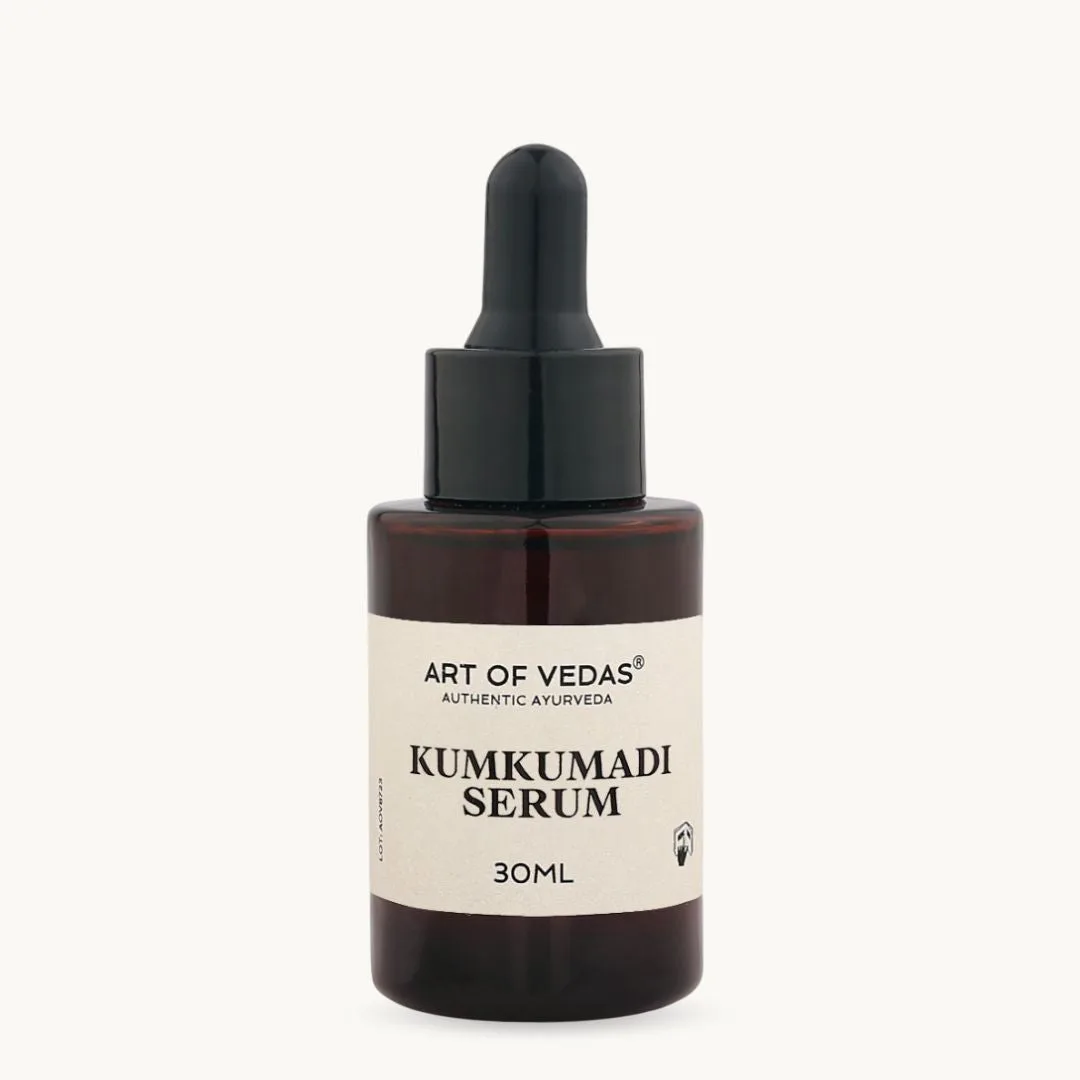
Its classical place is the face: an evening face oil connected with the complexion (Varna). Kumkumadi Thailam, Kumkumadi oil and Kumkumadi Serum name the same oil, while Kumkumadi Lepam is a paste form; see what Kumkumadi oil is. If you are choosing between Kumkumadi and Nalpamaradi, see Kumkumadi or Nalpamaradi.
Eladi Thailam in Classical Texts
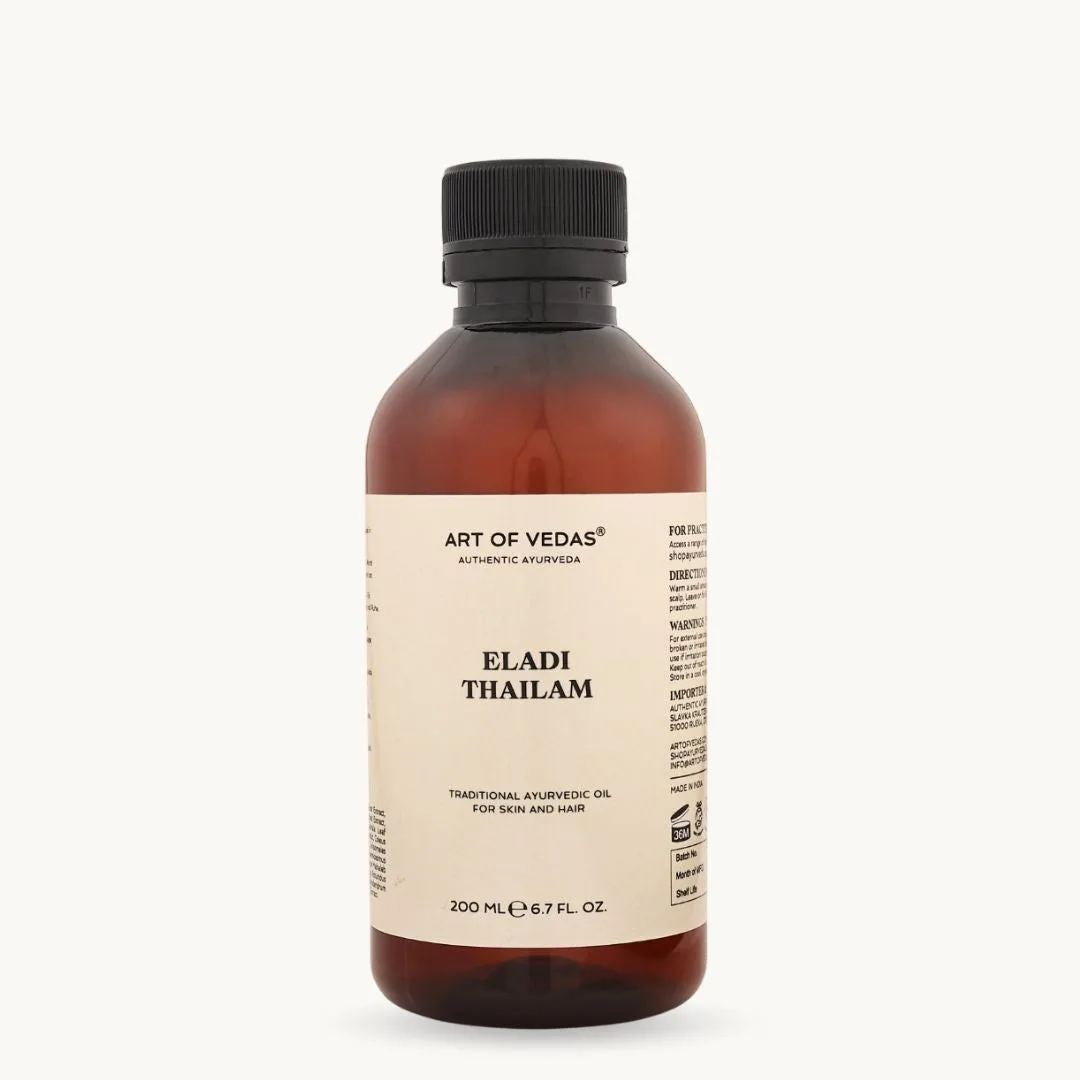
Eladi Thailam is documented most completely in the Sahasrayogam - a comprehensive traditional Ayurvedic formulary - and referenced in the Bhaishajya Ratnavali and several other classical compilations. As we detail in our classical texts and history guide, Eladi is a considerably more complex formula, typically specifying 25 or more botanical ingredients.
Eladi is described as the broader formula, for daily care of the skin of face and body.
Head-to-Head: Ingredients
Kumkumadi Thailam: the core formula
Kumkumadi takes its name from saffron, which leads the formula. The Art of Vedas Kumkumadi Serum declares saffron, liquorice root, lotus flower, Manjishtha root, turmeric root, the bark of two fig trees (Ficus benghalensis and Ficus lacor), blue lotus flower and rose water in a base of sesame seed oil.
The overall profile of Kumkumadi: led by saffron, a Varnya formula for the complexion, with a warm scent of saffron and herbs.
Eladi Thailam - The Core Formula
Where Kumkumadi is relatively focused, Eladi Thailam is deliberately comprehensive. As we detail fully in our complete ingredients guide, Eladi contains 25 or more botanical ingredients across multiple therapeutic categories.
Key ingredients in Eladi but typically absent from Kumkumadi:
Ela (Green Cardamom) - Elettaria cardamomum and Sthoola Ela (Black Cardamom) - Amomum subulatum: The namesake ingredients, present in significant quantities. Cardamom provides antimicrobial activity, mild anti-inflammatory effects, and the formula's characteristic bright, cooling aromatic quality.
Tuvaraka - Hydnocarpus laurifolia: A traditional Ayurvedic herb with strong skin-clarifying and antimicrobial applications. Not typically present in Kumkumadi.
Shaileya (Stone Flower) - Parmelia perlata: A lichen providing aromatic fixative properties and anti-inflammatory effects. Characteristic of complex traditional Ayurvedic oil preparations.
Daruharidra - Berberis aristata: Indian barberry, with berberine-rich bark providing antimicrobial and skin-clarifying properties.
The result: Eladi has a significantly broader active compound profile than Kumkumadi, particularly in the areas of antimicrobial activity and complex aromatic composition.
The Aroma Difference
Kumkumadi Thailam smells like: saffron and herbs, warm, slightly sweet and earthy. The impression is rich but simple in structure.
If you appreciate complex, evolving aromatic profiles, Eladi tends to be the more interesting experience. If you prefer a simpler scent led by saffron, Kumkumadi may appeal more on aroma alone.
Skin Type Matching: Which Oil for Which Skin?
Vata Skin (Dry, Delicate, Fine Lines, Dull)
Both oils work well. Vata skin benefits from the deep nourishment of a sesame oil base and the warming, tissue-building properties that both formulas share. Eladi's broader formula provides comprehensive support for vata skin's multiple characteristics - dryness, delicateness, sensitivity to cold and wind.
Best approach: Eladi Thailam as the daily oil; Kumkumadi as the evening face oil on some evenings, especially in the cooler months.
Pitta Skin (Sensitive, Reactive, Heat-Related Concerns)
Kapha Skin (Oily, Congestion-Prone, Sluggish Complexion)
Eladi Thailam is the usual choice. Its aromatic herbs and a light application suit Kapha skin. Kumkumadi, led by saffron, is used more sparingly on oily skin.
Best approach: Eladi Thailam in the evening, in a light application. Kumkumadi can be used on Kapha skin as a thin layer in the evening.
Uneven Tone or Dull Complexion
Kumkumadi is the saffron formula of the Varnya tradition, connected with an even-looking complexion. If an even-looking, radiant complexion is your main wish and your skin is not very oily or reactive, Kumkumadi is the natural choice; Eladi also contains saffron.
Mature Skin
Use both. Many people with mature, dry skin use Eladi as the daily oil and Kumkumadi as the evening face oil on some evenings.
For more on how to integrate both oils into a broader Ayurvedic skincare approach, see our complete application guide.
The Vegan Question
This is a practical consideration often overlooked in comparison articles. Some traditional Kumkumadi Thailam formulas include ingredients of animal origin, so it is worth checking the composition of the oil you choose.
Art of Vedas Kumkumadi contains no lac resin and no milk. Its composition is entirely plant-based: saffron and the other herbs of the formula, processed in sesame oil.
Eladi Thailam is entirely plant-based as well. Every ingredient in a classically prepared Eladi Thailam is derived from botanical sources: herbs, spices, tree barks, resins, and plant oils. No animal products are used. For those following a vegan lifestyle, both oils are therefore suitable in composition, and the choice can rest on your skin type and the result you are looking for.
Price Comparison
Kumkumadi Thailam and Eladi Thailam are both premium products, because saffron and a traditional preparation have their price. As we explain in our quality and authenticity guide, a very cheap Ayurvedic oil deserves a careful look at its ingredient list.
In the European market, Kumkumadi is often priced slightly above Eladi, because saffron leads its formula. For daily use as a basic face oil, Eladi Thailam often represents good value.
How to Use Both Oils Together
If you want the full benefit of both classical formulas, the most intelligent approach is to use them in complementary roles rather than as alternatives to each other.
Morning: Eladi Thailam - 3 to 4 drops as your daily protective and nourishing oil. Its antimicrobial, anti-inflammatory, and barrier-supporting properties make it ideal for starting the day. Always follow with SPF.
Evening (regular nights): Eladi Thailam again - 4 to 6 drops with a full mukhabhyanga ritual. The calming aromatic compounds support nervous system transition toward rest.
Evening (some evenings a week): Kumkumadi Thailam, a few drops, usually two to four, on clean skin on its own, or first, before Eladi, letting it absorb for a few minutes.
This way you combine Eladi as the daily oil with Kumkumadi as the evening face oil.
Combine either or both with our Kansa wand facial massage tools for a complete traditional Ayurvedic facial ritual. The Kansa wand works beautifully as a massage tool with both oils, enhancing absorption and providing additional benefits through the traditional bronze metal's balancing properties.
The Honest Bottom Line
Choose Eladi Thailam if: You want a comprehensive daily facial oil. Your skin is sensitive, reactive, or prone to heat-related concerns. You have oily or congestion-prone skin that also needs brightening. You value aromatic complexity and a genuine multi-herb traditional formula. You are new to traditional Ayurvedic oils and want one product that covers the full range of daily facial wellness needs.
Choose Kumkumadi Thailam if: you want the classical saffron face oil for the evening and an even-looking, radiant complexion, and your skin is not very oily or reactive. You are drawn to a scent led by saffron.
Use both if: You want the most comprehensive traditional Ayurvedic facial care possible, your skin is mature or dealing with multiple concerns simultaneously, and you want to experience both classical formulas in their intended complementary roles.
At Art of Vedas, our starting point is always Eladi Thailam - because its comprehensive formula makes it the most versatile and universally suitable traditional Ayurvedic facial oil we know of. Explore our full collection of traditional Ayurvedic Thailams to find the right combination for your skin.
Frequently Asked Questions
Can I use Eladi Thailam and Kumkumadi together in the same application?
Yes: apply one first, let it absorb for a few minutes, then apply the second. Kumkumadi is usually applied first, followed by Eladi. Use fewer drops of each than you would of either alone.
Can men use these oils?
Absolutely. Traditional Ayurvedic facial care is not gender-specific. Both Eladi Thailam and Kumkumadi Thailam are suitable for all genders. The facial Abhyanga practice, daily oil application, and skin wellness benefits are equally relevant regardless of gender.
Continue Exploring
Explore more in this series