Shallaki is the fragrant resin of the Indian frankincense tree, a substance that classical Ayurveda has valued for its cooling, drying character and its long association with comfortable, easy movement. Gathered as a gum-resin from the bark of a hardy deciduous tree, it belongs to the same wider family of aromatic resins that many cultures have prized. This monograph sets out its botanical identity, classical role, traditional forms and respectful context.
Botanical identity
Shallaki is the oleo-gum-resin of Boswellia serrata, a branching deciduous tree of the dry hills of India. When the bark is incised, the tree exudes a resin that hardens into fragrant tears, and it is this purified resin that classical Ayurveda uses. The tree is a close relative of the Boswellia species that yield frankincense, which places Shallaki within a long and shared human history of aromatic resins.
Classical Ayurvedic role
Classical descriptions give Shallaki a Tikta and Kashaya Rasa, a bitter and astringent taste, with qualities that the texts read as cooling and drying. Within the Ayurvedic framework it is traditionally associated with Sandhi, the joints, and with supporting comfortable, unrestricted movement as part of an active routine. It is also grouped with the resins used to steady Kapha and to keep the channels clear. These are traditional statements of the herb's classical character and role, offered as context rather than as any claim of medical effect.
Traditional preparation forms
- As a purified resin, since classical method places emphasis on correct cleaning of the raw gum before use.
- As a Churnam, the dried resin powdered and taken with a suitable Anupana.
- Within Guggulu-style compound tablets, where resins are traditionally combined with other herbs.
- In the modern capsule, which carries the powdered resin in a convenient daily form.
How Shallaki appears in Art of Vedas formulations
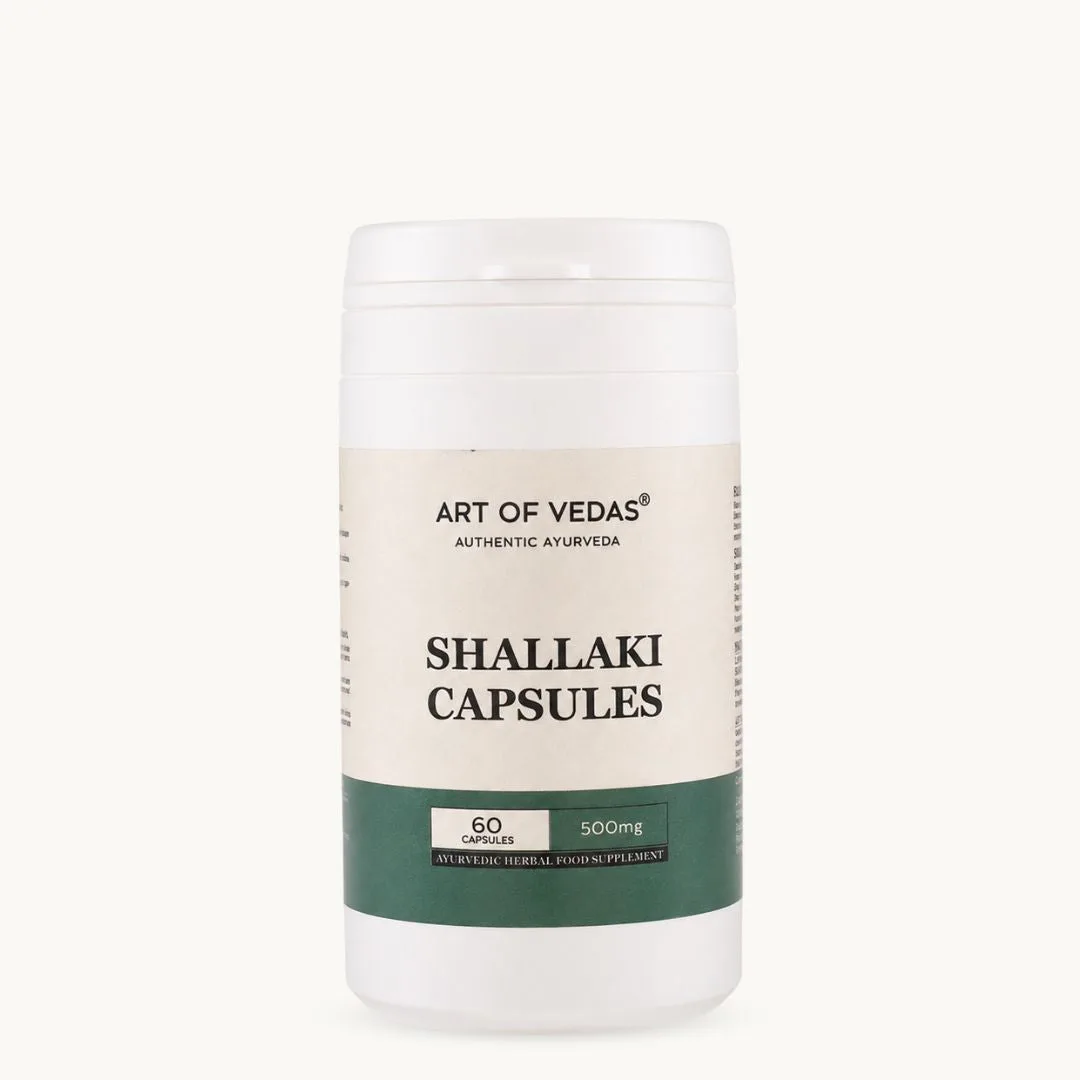
In prose, Shallaki reaches the Art of Vedas range as capsules, presenting the purified, powdered resin in a straightforward daily format. Because it belongs to the classical resin tradition, it sits naturally alongside the Guggulu-based tablets that Ayurveda groups with comfortable movement and clear channels. You can view Shallaki capsules and, within the classical tablet tradition, the Yogaraj Guggulu Gulika. To understand the tablet form and the wider herb context, see the Gulika and Vati tablets guide, the Churnam powder formulation guide, and the related Gokshura monograph.
Respectful cultural context
Shallaki carries the quiet authority of a substance used across many traditions, valued for its fragrance and its steadiness. Art of Vedas presents it as a classical Ayurvedic resin with a long documented history, to be used thoughtfully and, where personal use is considered, with the guidance of a qualified practitioner.
Frequently Asked Questions
What is the botanical name of Shallaki?
Shallaki is Boswellia serrata, a deciduous tree of the dry Indian hills. Its purified oleo-gum-resin is the part used in classical Ayurveda, and it is a close relative of the frankincense trees.
Is Shallaki the same as frankincense?
They are closely related. Shallaki, from Boswellia serrata, belongs to the same genus as the Boswellia species that yield frankincense, so it sits within a shared history of aromatic resins while remaining its own classical Ayurvedic substance.
What are the classical qualities of Shallaki?
Classical descriptions give it a Tikta and Kashaya Rasa, bitter and astringent, with cooling and drying qualities. It is traditionally associated with the Sandhi or joints and with supporting comfortable movement.
In what forms is Shallaki traditionally used?
It appears as a purified resin, as a Churnam powder, within Guggulu-style compound tablets, and in the modern capsule that carries the powdered resin in convenient daily form.
Which Art of Vedas product contains Shallaki?
Art of Vedas offers Shallaki as capsules, presenting the purified, powdered resin in a simple daily format alongside the classical Guggulu tablet tradition.
This product is a food supplement and not intended to diagnose, treat, cure or prevent any disease.