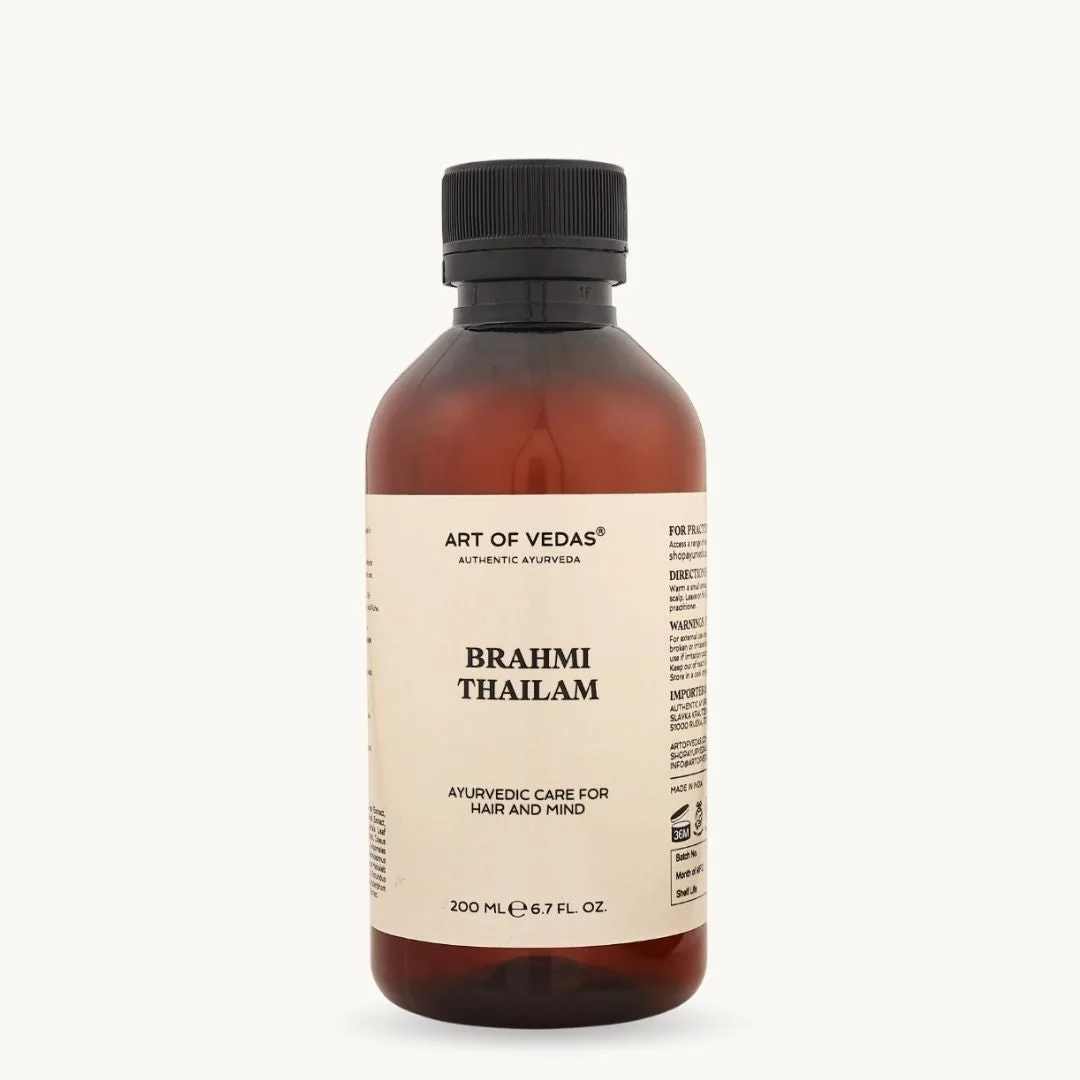
Shiroabhyanga (the Ayurvedic head massage with warm oil) needs no training to practise at home. It needs warm oil, ten to fifteen unhurried minutes, and a sequence worth repeating until your hands know it. Here is the sequence.
What you need
A proper head oil, a small bowl of hot water to stand the bottle in, an old towel for the shoulders, and a quiet quarter of an hour. The classical recipes for the head combine sesame with Amla, Bhringraj and Brahmi; our Shiroabhyanga Oil is composed this way. Warm the oil to just above skin temperature. Warm oil spreads further, sits better and feels entirely different from cold.
The sequence
Begin at the crown. Pour a small amount of oil onto the highest point of the head and rest your palm on it for a moment before you start to move. Work the oil outward from the crown in slow circles with the pads of the fingers, covering the whole scalp section by section, as if combing it with your fingertips. Do not rush this part; it is most of the practice.
Move to the temples. Small, light circles with the fingertips, eyes closed. Continue behind the ears and down to the base of the skull, where the neck meets the head, and spend real time there. Finish by drawing the hands down the neck to the shoulders a few times, carrying the last of the oil with them.
Timing and washing
Leave the oil in for at least half an hour after the massage. Longer is traditional: many practitioners oil in the evening and wash the next morning. If you sleep with the oil in, cover the pillow with a towel. Wash out with a gentle shampoo; you may need to lather twice. Two to three evenings a week is a solid rhythm, and the strict classical habit is daily.
Small refinements
Once the basic practice is settled, two additions deepen it. A Kansa scalp massager (Kansa is the traditional Ayurvedic bronze alloy) can open and close the session, waking the scalp before the oil and distributing it evenly after. And on quiet weekends, extending the massage to the whole body turns the head ritual into a full Abhyanga practice.
Contains sesame, almond oil and natural essential oils; the oil is not recommended during pregnancy or while breastfeeding, and a patch test is sensible for sensitive skin.
For external use only. Not a substitute for professional medical advice.