In brief: A 101 Avarthy is not a stronger version of a Thailam. It is the same classical preparation put back through the whole cooking cycle one hundred and one times, which leaves very little oil and a great deal of concentration. That is why it arrives in a 10 or 15 ml bottle rather than a 200 ml one.
What the number actually counts
Avartana means a turn, a going round. One Avartana is one complete pass of the classical method: the oil is cooked with a freshly prepared herbal decoction and paste, slowly, until the water has gone and only the oil and the herbal extract remain. An ordinary Thailam, the medicated oil of Ayurveda, has been through that once.
A 101 Avarthy has been through it one hundred and one times, each round starting again with a fresh preparation of the herbs. The work is measured in weeks, and the yield falls with every pass. That is the whole of the difference, and it is also the whole of the reason for the price and for the size of the bottle.
The two we hold, and how they differ
Art of Vedas carries two, and they are not interchangeable. They concentrate different formulations, and more importantly they are used in different ways.
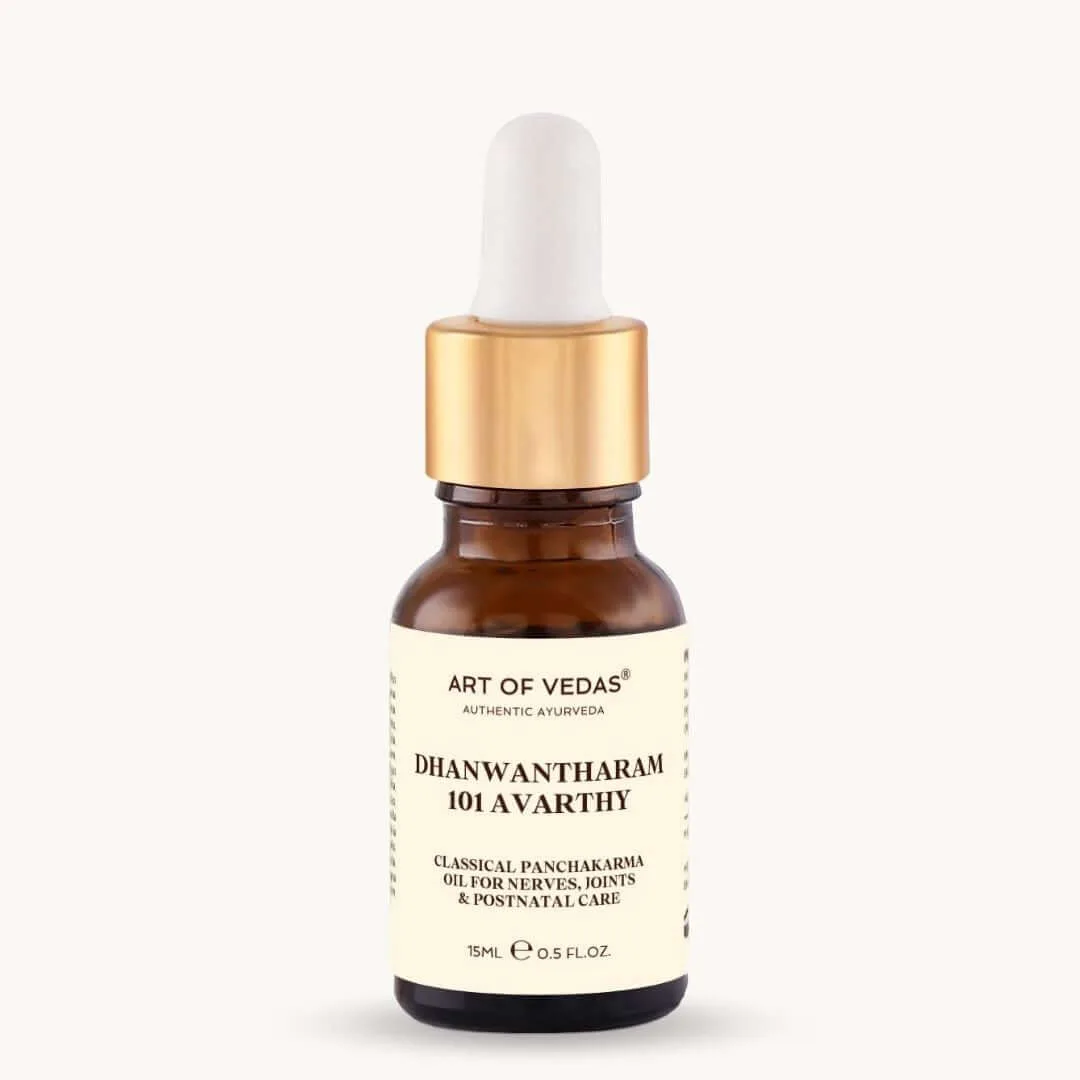
Dhanwantharam 101 Avarthy
Dhanwantharam 101 Avarthy concentrates the Dhanwantharam formulation, the preparation named for Dhanwantari and classically associated in Ayurveda with Vata, the Dosha, or functional principle, governing movement, dryness and cold. It is supplied in 15 ml and is taken in drops under the guidance of a qualified Ayurvedic practitioner. It is not a preparation to work out for yourself. Our guide to Dhanwantharam 101 Avartana goes through the formulation in detail.
Ksheerabala 101 Avarthy
Ksheerabala 101 Avarthy concentrates the Ksheerabala formulation, which is built on a sesame base with Bala, the classical name for Sida cordifolia. Art of Vedas supplies it in 10 ml as an external oil: a few drops on the scalp, at the temples, along the spine or over a single area, worked in slowly. It is not taken by mouth. The Ksheerabala 101 guide sets out the preparation, and our guide to Bala covers the root itself.
Read the bottle, not the Sanskrit name
This is the part most people get wrong, and it is worth stating plainly. Two bottles can carry the same classical name, the same Avartana count and much the same appearance, and still be supplied for entirely different purposes. The category a preparation is placed in is set by the company responsible for it in its own market, not by the Sanskrit name on the front.
So the rule is simple. Read the bottle in your hand. If it says external use, it is an external oil, whatever a classical text says about the older practice. If it is supplied for internal use, it will say so, and it will point you at a practitioner.
Why the bottle is small, and how far it goes
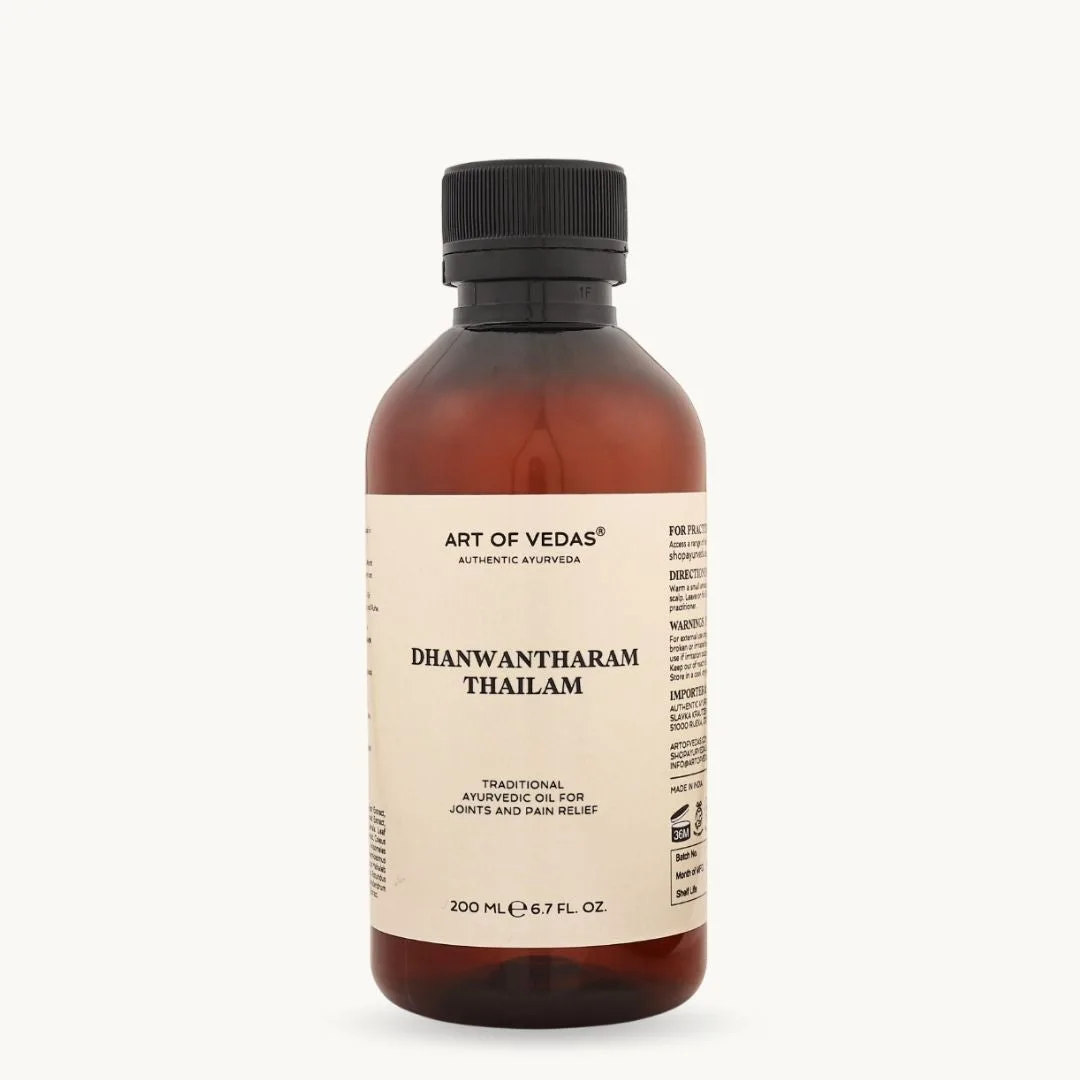
A 10 ml bottle looks slight next to a 200 ml Thailam, and the comparison misleads. A 101 Avarthy is used in drops rather than by the palmful. Three or four drops will cover the temples and the crown of the head, and a bottle used two or three times a week lasts a long while.
The practical consequence is that a 101 Avarthy does not replace a full size oil. It sits beside one. Most people who keep both use a Thailam for the body in the usual way and keep the concentrate for a single area. Both of ours sit together in the 101 Avarthy range.
Keeping it well
Cool, dark, closed and upright, away from the cooker and the window. The long cooking gives a 101 Avarthy a distinct aroma, which is expected and is not a sign that anything has turned. Water is the one thing to keep out, so use a dry hand and never return oil to the bottle once it has left it.
Frequently asked questions
Is 101 Avarthy the same as 101 Avartana?
Yes. Avarthy, Avarthi, Avartana and Avarthanam all transliterate the same word for a repetition of the cooking cycle. The spelling varies by convention rather than by preparation. It is the count that carries the meaning.
Is a 101 Avarthy simply a stronger Thailam?
Not in the way that phrase suggests. It is more concentrated, because the same herbal character has been carried into a much smaller volume of oil, but it is a different article with a different manner of use rather than the same oil at a larger dose.
Can I use a 101 Avarthy for a full body Abhyanga?
It is not intended for that, and it would be an expensive way to go about it. Abhyanga, the classical warm oil self massage, asks for a generous quantity of oil, which is exactly what a full size Thailam is for. Our Abhyanga guide covers the quantities.
Why do the two bottles differ in size?
Because they are supplied for different purposes and packed accordingly. 10 ml and 15 ml are both drop quantities, and the difference between them says nothing about the Avartana count, which is the same.
Which of the two should I start with?
If you are buying for yourself and want an oil you can use without supervision, the external one is the straightforward answer. If a practitioner has named a preparation for you, buy the one they named, in the form they named it in.
Is a 101 Avarthy suitable during pregnancy?
Ask before you use it. Speak to your doctor or a qualified Ayurvedic practitioner before using any concentrated classical preparation if you are pregnant or breastfeeding, if you take prescribed medication, or if it is intended for a child.