In brief: Dashmoola is not a single herb but ten separate roots, five taken from trees and five from smaller shrubs and creeping plants, combined into one classical Ayurvedic preparation known for its warming, grounding character.
One formula, ten different plants
Most Ayurvedic herbs are one plant with one name. Dashmoola is a group. The word means ten roots, and the classical texts treat those ten as one substance with one character, much as a European herbalist treats a fixed tisane blend rather than its separate leaves. The ten divide into two families of five, by the size of the plant each root was taken from.
This grouping is old. It appears across the classical compendia, including the Charaka Samhita and the Ashtanga Hridayam, where the ten are handled as a set and almost always in the context of Vata (the Dosha, or functional principle, governing movement, dryness and cold in the body).
Brihat Panchamoola, the five roots of the great trees
- Bilva, Aegle marmelos
- Agnimantha, Premna serratifolia
- Shyonaka, Oroxylum indicum
- Patala, Stereospermum suaveolens
- Gambhari, also called Kashmari, Gmelina arborea
Laghu Panchamoola, the five roots of the smaller plants
- Shalaparni, Desmodium gangeticum
- Prishniparni, Uraria picta
- Brihati, Solanum indicum
- Kantakari, Solanum virginianum
- Gokshura, Tribulus terrestris
The words brihat and laghu describe the plant, not the strength of the root, and classical Ayurveda treats the smaller half of the formula as fully the equal of the tree roots. Gokshura is also taken on its own as Gokshura capsules, and readers who know it only in that form are often surprised to find it sitting inside a much older group.
Why the root, and not the leaf or the fruit
Ayurveda pays close attention to which part of a plant is used, because different parts carry different qualities. A leaf is light and quick. A root is the part that holds a plant steady, draws from below, and works slowly. Those same words, heavy, slow, warm, describe what classical Ayurveda wants when Vata has become excessive, since Vata is defined by the opposite qualities: light, mobile, dry and cold.
That is the logic of Dashmoola in one sentence. It is a preparation chosen for what roots are, applied to a Dosha that behaves as the inverse. The formula is classically described as Vata Kapha shamana, meaning the tradition directs it towards settling both Vata and Kapha.
The qualities the classical texts assign
- Rasa (taste): predominantly tikta, bitter, with katu, pungent, and kashaya, astringent
- Virya (potency): ushna, warming
- Dosha: classically suited to reducing Vata and Kapha, with more care needed in Pitta
- Agni (the digestive and metabolic fire): classically described as supporting rather than dulling it
The warming potency matters in practice. Someone in the middle of a European heatwave has less use for a warming root decoction than someone in a cold, dry, windy autumn, and Ritucharya (the classical seasonal routine) places Dashmoola firmly in the darker part of the year.
The forms Dashmoola takes
Because the ten roots are woody, they are almost never eaten as such. They are extracted, and the extraction method defines the preparation.
Kashayam and Arishtam
Kashayam is a water decoction: the coarse root powder is simmered until the volume falls sharply, then strained and taken warm. Arishtam is the fermented form, where the decoction is left with a sugar source to ferment slowly, which both preserves it and changes its character. If multi herb formulas are new to you, our guide to Triphala applies the same logic to a much simpler three fruit group.
Churnam, the powder
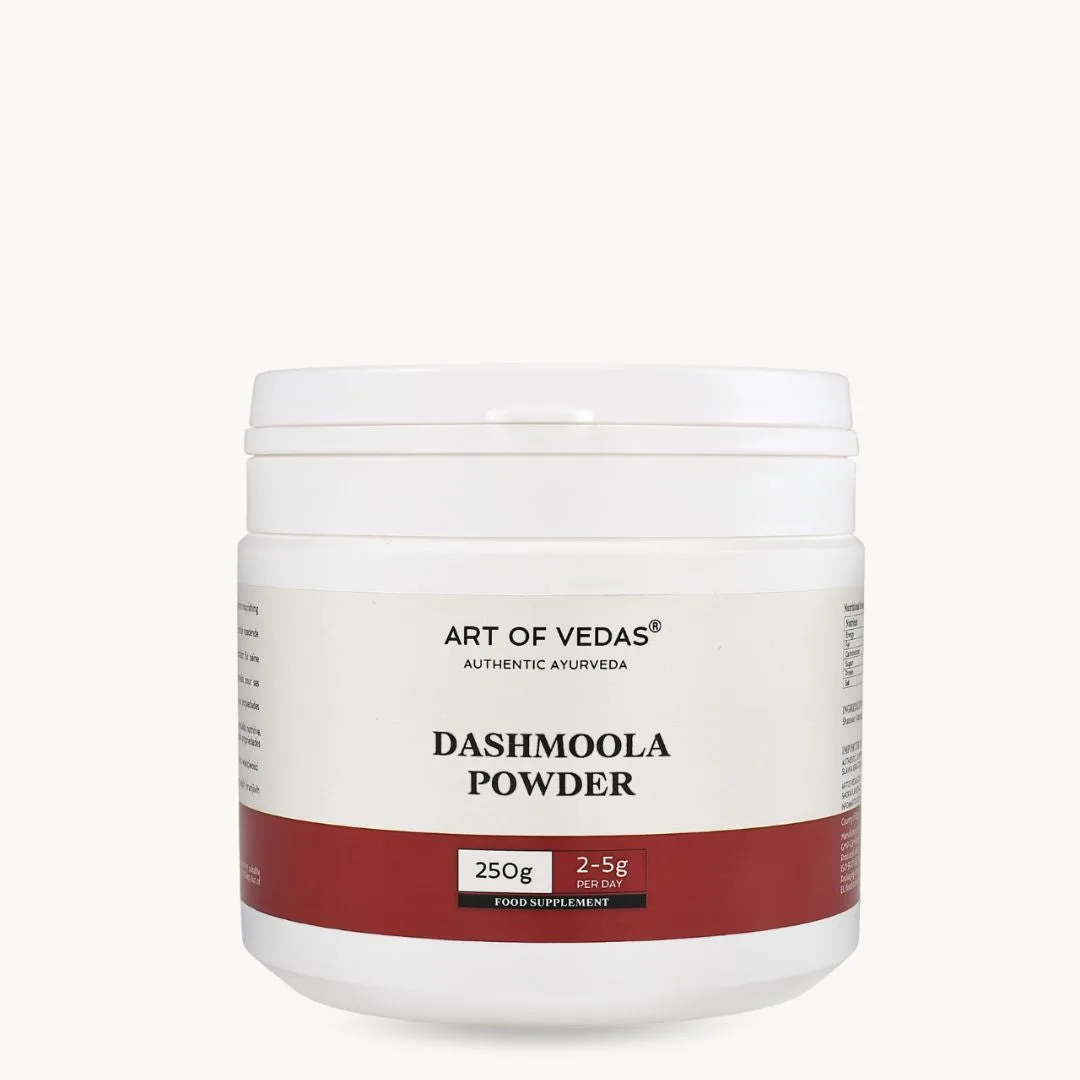
Dashmoola Powder is the Churnam (powdered) form, and the one a household can work with directly, since from it you can make a fresh decoction whenever you want one rather than buying a ready made liquid. It is also the form practitioners use to prepare a kwatha for external work.
External use
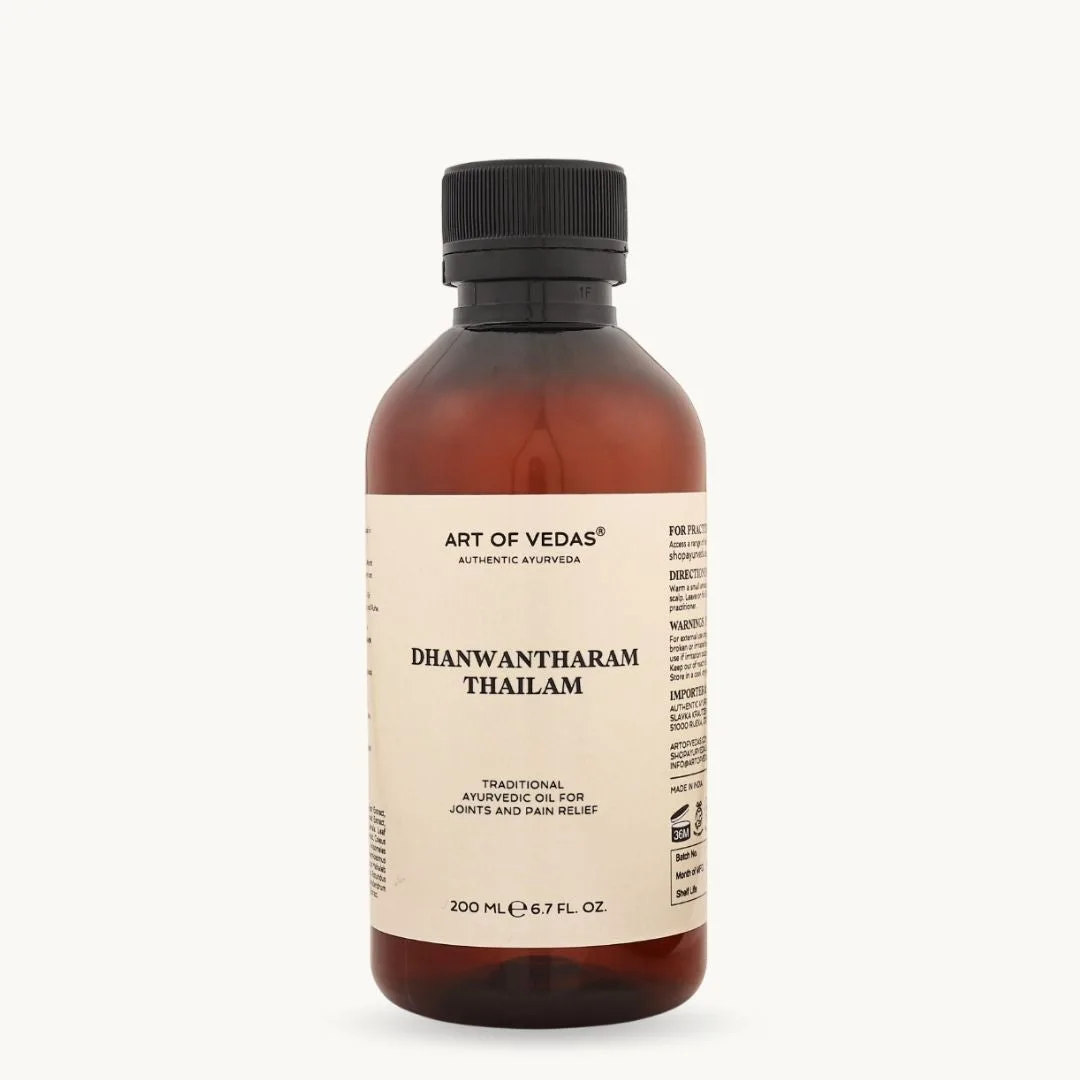
A Dashmoola decoction is not only taken internally. It is used as a warm liquid for compress and steam work, and the ten roots also appear in the decoction base of several classical medicated oils. Dhanwantharam Thailam is one of these, an oil whose classical preparation begins with a root decoction rather than with plain oil.
Dashmoola in professional practice
In a Panchakarma (the classical programme of five Ayurvedic procedures) setting, Dashmoola appears more often as a kwatha than as a powder taken by mouth. Warm decoction is used in swedana, the sweating and steaming stage, and it is among the liquids commonly kept prepared in a treatment room. A clinic can therefore work through a great deal of it in a week, where a household may use the same quantity over several months. Practitioners working out what to hold in quantity will find the practical side in our notes on planning oils for a Panchakarma room.
Using Dashmoola Powder at home
The traditional decoction is simple to make and needs no equipment beyond a small pan.
- Use roughly one to two grams of the coarse powder, about half a teaspoon, per cup
- Add around 200 ml of water and bring it to a low simmer
- Let it reduce by about half, which usually takes ten to fifteen minutes
- Strain well, since the root particles are gritty, and drink it warm
The taste is bitter and astringent, and nothing about it is pleasant at first. That is expected: in classical Ayurveda, tikta rasa is a quality with a purpose, not a flaw to be corrected.
Traditionally the decoction is taken warm, and within Dinacharya (the classical daily routine) it sits naturally in the early morning or the early evening rather than late at night. Many people pair it seasonally with external Vata care, such as Abhyanga (the classical warm oil self massage) with a Vata massage oil during autumn and winter. Our guide to Bala covers another root classically grouped with Vata care, and the two are often discussed together.
Care, and who should ask first
Dashmoola is a warming preparation with a long traditional record, but it is not a casual daily habit for everyone. Seek advice from a qualified Ayurvedic practitioner or your doctor before using it if you are pregnant or breastfeeding, if you take prescribed medication, or if you are preparing for a medical procedure. The same applies if it is intended for a child. Food supplements do not replace a varied diet or medical advice.
Frequently asked questions
Is Dashmoola the same as Dashamoola or Dashmool?
Yes. All three transliterate the same Sanskrit word, dasha meaning ten and moola meaning root. You will also see Dasamula and Dashamula. The spelling varies by convention, not by formula: the name refers to the same ten roots in each case.
Are the ten roots always the same ten plants?
The ten Sanskrit names are fixed. In practice a closely related botanical species is sometimes accepted for one of them where the classical plant is scarce, which is why you will occasionally see two Latin names given against a single Sanskrit name.
Is Dashmoola warming or cooling?
Warming. Its virya, or potency, is classically ushna, and that one quality governs most of how the tradition places it. A practitioner may still direct it towards a Pitta predominant person within a specific preparation, where the other ingredients temper the heating character.
Should I take Dashmoola as powder or a ready made Kashayam?
The powder gives you a decoction made fresh each time, at the cost of fifteen minutes on the stove. A bottled Kashayam or Arishtam is ready to pour and keeps on a shelf. The useful question is which of the two you will actually keep up through a whole winter.
Can Dashmoola be taken together with Triphala?
They are often used within the same routine rather than in the same cup. The usual convention follows the character of each: the warming decoction in the earlier part of the day, Triphala in the evening, with a clear gap between them. A practitioner will adjust that timing to your constitution.
How long is Dashmoola traditionally used for?
Classical use is seasonal or course based rather than indefinite: a few weeks during the colder months, then a pause, rather than a year round habit. If you are considering anything longer, that is the point at which a practitioner should be involved.