Dhanwantharam Thailam vs Mahanarayana Thailam: Which Ayurvedic Oil Is Right for You?

Navigating the World of Classical Ayurvedic Oils

Ayurveda offers a rich tradition of herbal oils designed not as quick solutions, but as long-term companions to daily life. Among these, Dhanwantharam Thailam and Mahanarayana Thailam are two of the most respected classical formulations. Both are deeply rooted in traditional texts and widely used in oil massage (abhyanga) and body-care rituals. Yet, despite their shared heritage, they differ significantly in character, composition, and traditional context of use.

At Art of Vedas, we approach these oils not as interchangeable wellness products, but as living expressions of Ayurvedic philosophy—each with its own rhythm, intention, and role in daily self-care.

Modern wellness seekers often encounter confusion when choosing between these two oils. Is one “stronger” than the other? Are they interchangeable? Or does Ayurveda offer a more nuanced way to decide? Rather than framing the choice in terms of problems and cures, classical Ayurveda encourages selection based on constitution (prakriti), lifestyle, season, and life stage.

This article offers a clear, tradition-aligned comparison of Dhanwantharam Thailam and Mahanarayana Thailam—without medical claims or promises. Instead, we focus on how each oil is traditionally understood, how it feels in practice, and how it fits into everyday Ayurvedic self-care. By the end, you’ll have a grounded framework to help you choose the oil that best supports your personal wellness rituals.

Understanding Classical Ayurvedic Oil Formulations

In Ayurveda, medicated oils (taila) are created through a meticulous process that blends herbal decoctions, herbal pastes, and a carrier oil—most commonly sesame oil. This process, described in texts such as the Ashtanga Hridaya, is designed to transfer the energetic qualities (guna) of herbs into the oil medium.

Importantly, these oils are not generic. Each formulation reflects a specific intention:
● Some oils emphasize nourishment and grounding
● Others emphasize warmth, stimulation, or mobility
● Many are designed to be used ritually, over time

Art of Vedas follows these classical preparation principles closely, respecting both the method and the intention behind each formulation.

Dhanwantharam Thailam and Mahanarayana Thailam share a Vata-balancing orientation, yet they express this goal through different herbal profiles and sensory experiences.

Dhanwantharam Thailam: Composition and Traditional Character

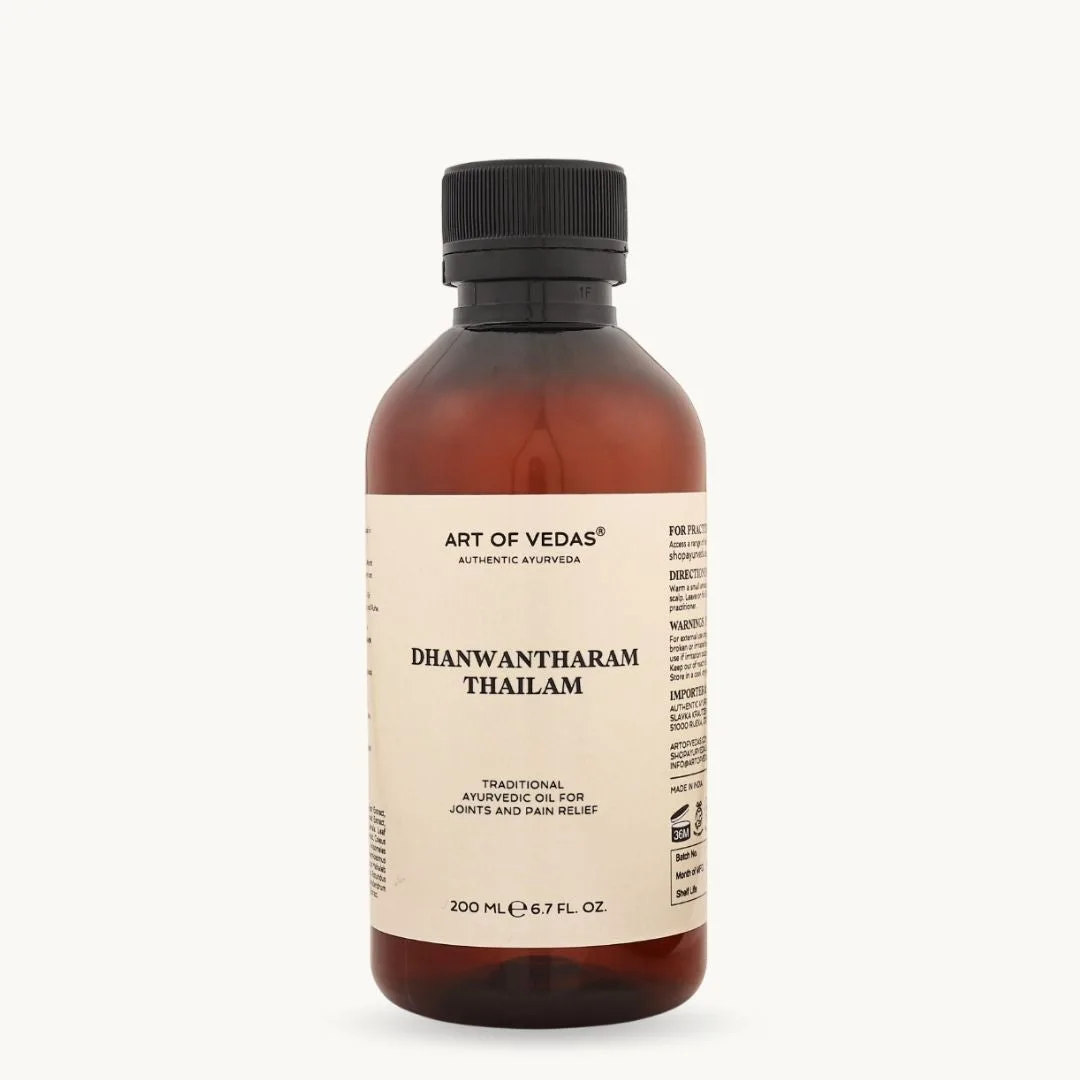
Dhanwantharam Thailam is traditionally associated with steadiness, nourishment, and gentleness. Its formulation includes over 30 herbs such as Bala, Shatavari, Ashwagandha, and Yastimadhu, processed in a sesame oil base.

From a traditional perspective, this oil is valued for:
● Its grounding and stabilizing qualities
● Its suitability for regular, long-term oil massage
● Its compatibility with slower, restorative routines

The overall character of Dhanwantharam Thailam is soft yet substantial. At Art of Vedas, it is often chosen by those seeking consistency and subtle support in their daily abhyanga practice rather than intensity.

Mahanarayana Thailam: Heritage and Herbal Profile

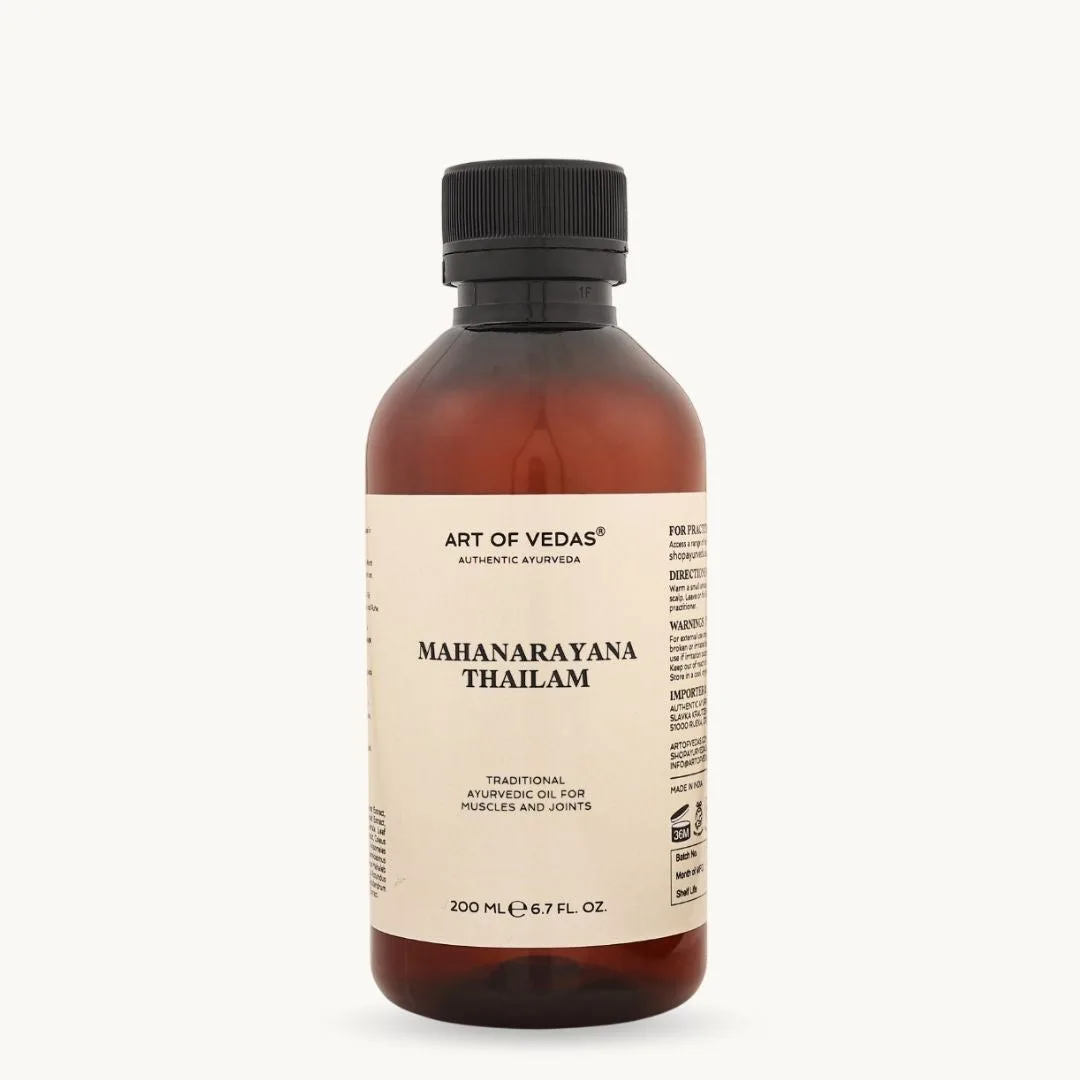
Mahanarayana Thailam is a more complex and expansive formulation, containing a larger number of herbs, including Dashamoola, Ashwagandha, and various warming botanicals. Traditionally, it is associated with movement, engagement, and activation.

In classical usage, Mahanarayana Thailam is known for:
● A richer, heavier herbal aroma
● A warming, penetrating sensory quality
● A more stimulating massage experience

This oil often feels more assertive on the body. Within the Art of Vedas collection, it is typically approached as a focused ritual oil rather than an everyday staple.

Key Differences in Ingredient Profiles

While both oils share some overlapping herbs, their emphasis differs.

Dhanwantharam Thailam tends to highlight:
● Nourishing and stabilizing herbs
● A relatively balanced, gentle synergy
● Long-term compatibility with frequent use

Mahanarayana Thailam tends to highlight:
● A broader and denser herbal spectrum
● Warming and activating botanicals
● A more intense sensory footprint

These differences do not indicate superiority—only distinction. Ayurveda values appropriateness over universality, a principle Art of Vedas emphasizes across its formulations.

Traditional Uses: When Ayurveda Recommends Each Oil

Traditionally, oil selection is contextual rather than absolute.

Dhanwantharam Thailam is often chosen for:
● Daily self-massage rituals
● Gentle, rhythmic abhyanga
● Life phases emphasizing restoration and grounding

Mahanarayana Thailam is often chosen for:
● Periodic, focused massage sessions
● Shorter-term ritual use
● Situations where warmth and engagement are preferred

Both oils are respected, but their traditional roles are not identical.

Vata, Pitta, Kapha: Dosha Considerations for Oil Selection

From a doshic perspective:
● Vata often resonates with both oils, depending on intensity and season
● Pitta may prefer moderation and careful timing, favoring gentler application
● Kapha may gravitate toward lighter or less frequent oiling

Ayurveda always emphasizes observation. How the oil feels on your body matters more than theory alone—a philosophy central to the Art of Vedas approach.

Texture, Absorption, and Sensory Experience Compared

Dhanwantharam Thailam typically feels:
● Smooth and moderately heavy
● Calmly absorbing with time
● Subtle in aroma

Mahanarayana Thailam typically feels:
● Heavier and more robust
● Warmer on application
● More pronounced in scent

These sensory qualities strongly influence personal preference.

Seasonal Considerations in Ayurvedic Oil Selection

Traditionally:
● Cooler, drier seasons often invite heavier oiling
● Transitional seasons encourage gentler, consistent routines

Some individuals working with Art of Vedas oils choose to alternate seasonally rather than commit to a single formulation year-round.

Life Stage and Traditional Applications

Prenatal and Postnatal Traditions: Why Dhanwantharam Is Preferred

In classical household traditions, Dhanwantharam Thailam is often favored during nurturing life phases due to its gentler and more stabilizing nature. This preference reflects cultural wisdom rather than medical positioning.

Athletic and Active Lifestyles: Comparing Both Oils

More active individuals sometimes alternate between oils—using Dhanwantharam Thailam for daily grounding and Mahanarayana Thailam for occasional, deeper massage rituals.

Price Point and Value Considerations

Mahanarayana Thailam is often more expensive due to its larger number of herbs. Dhanwantharam Thailam, while still complex, is sometimes more accessible for daily use. At Art of Vedas, value is understood as suitability and alignment, not price alone.

Can You Use Both? Rotating Ayurvedic Oils in Your Wellness Routine

Yes, rotating oils is a traditional practice. Ayurveda does not require exclusivity. Seasonal changes, lifestyle shifts, and personal intuition can guide rotation.

Expert Recommendations from Ayurvedic Tradition

Classical wisdom encourages:
● Listening to the body’s response
● Adjusting frequency rather than forcing consistency
● Treating oil rituals as nourishment, not obligation

Making Your Choice: A Decision-Making Framework

Choose Dhanwantharam Thailam if you value:
● Gentle, regular routines
● Subtle sensory presence
● Long-term consistency

Choose Mahanarayana Thailam if you value:
● A richer, warmer massage experience
● Periodic, focused oil rituals
● A more pronounced herbal character

Conclusion: Honoring Your Individual Wellness Journey

Dhanwantharam Thailam and Mahanarayana Thailam are not rivals—they are companions within Ayurveda’s expansive oil tradition. Each offers a distinct experience rooted in centuries of observation and ritual use. By choosing based on lifestyle, season, and personal resonance rather than promises or claims, you honor the true spirit of Ayurveda: awareness, balance, and self-knowledge.

At Art of Vedas, these oils are offered as invitations—to slow down, observe, and build a relationship with wellness that evolves with you.

Frequently Asked Questions

1. Which oil is better for prenatal wellness rituals—Dhanwantharam Thailam or Mahanarayana? 

Traditionally, Dhanwantharam Thailam is more commonly chosen due to its gentler, stabilizing nature.

2. Can I mix Dhanwantharam Thailam and Mahanarayana oils together? 

Traditionally, oils are used separately, but some people alternate them on different days.

3. Which oil absorbs faster into the skin?

Absorption varies by individual skin type and climate rather than oil alone.

4. Is one oil more suitable for cold weather than the other?

Both are traditionally used in cooler seasons; Mahanarayana feels warmer to some users.

5. Which oil has a stronger herbal scent?

Mahanarayana Thailam generally has a more pronounced aroma.

6. Can beginners start with either oil?

Yes, though many beginners find Dhanwantharam Thailam easier to integrate.

7. Are there any overlapping herbs in both formulations?

Yes, herbs like Ashwagandha appear in both, though in different proportions.

8. Which oil is traditionally recommended for Vata imbalance?

Both are Vata-oriented; choice depends on desired intensity and routine.
9. How do the costs of these two oils typically compare?

Mahanarayana Thailam is often priced higher due to its complex formulation.

10. Can I alternate between both oils in the same week?

Yes, alternating is consistent with traditional flexibility.