Mezhukupakam is the densest consistency stage among the classical fat preparations of Ayurveda. Where a Thailam pours and a Kuzhambu holds a soft semi-solid body, a Mezhukupakam is firmer still: a concentrated preparation that keeps its form in the jar and softens only under the warmth of the skin. Few terms of the tradition are so seldom explained for a European audience; this guide from Art of Vedas closes that gap.
What the Term Means
The word is Malayalam and falls into two parts. Pakam names the stage of preparation, the degree to which a classical composition has been reduced over regulated heat. Mezhuku describes the texture reached at that stage: soft, pliant and yielding, firm at rest and workable under warm fingers. A Mezhukupakam, then, is a preparation carried deliberately to this further degree of reduction. It stands at the far end of the consistency spectrum that begins with the liquid Thailam and passes through the semi-solid Kuzhambu, a spectrum we map fully in Thailam, Kuzhambu or Mezhukupakam.
How the Consistency Arises
Nothing is added to firm the preparation. Like its siblings, a classical Mezhukupakam is made from base fats, herbal decoction and herb paste, cooked slowly until the moisture has left; the extended reduction and the natural proportion of the fats alone give the finished preparation its dense body. This matters to careful readers: the firmness is a stage of the classical method, not the result of any thickening ingredient. The same recipe, stopped earlier, would remain a softer preparation; carried further, it sets into the concentrated form the name describes.
The Dhanwantharam Mezhukupakam
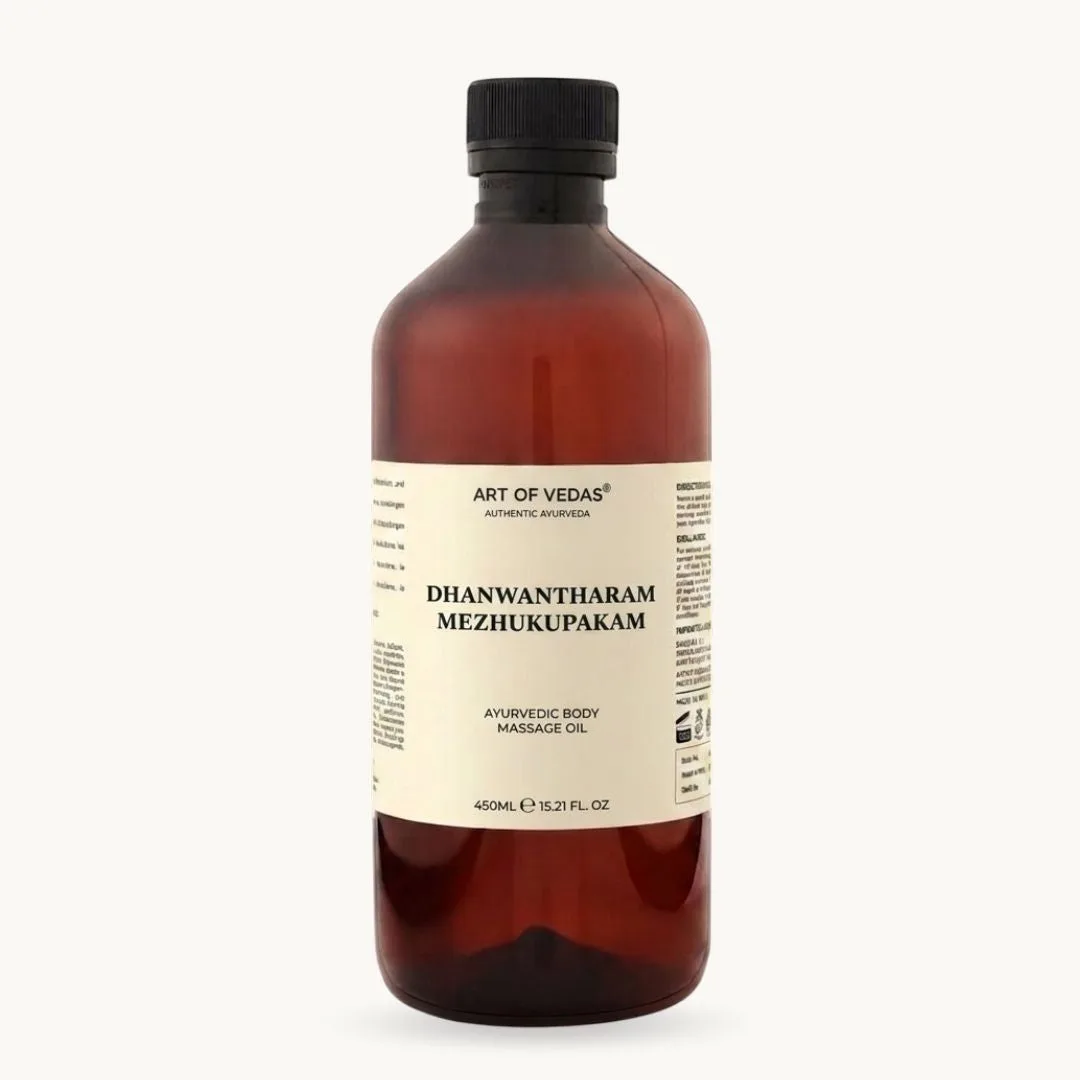
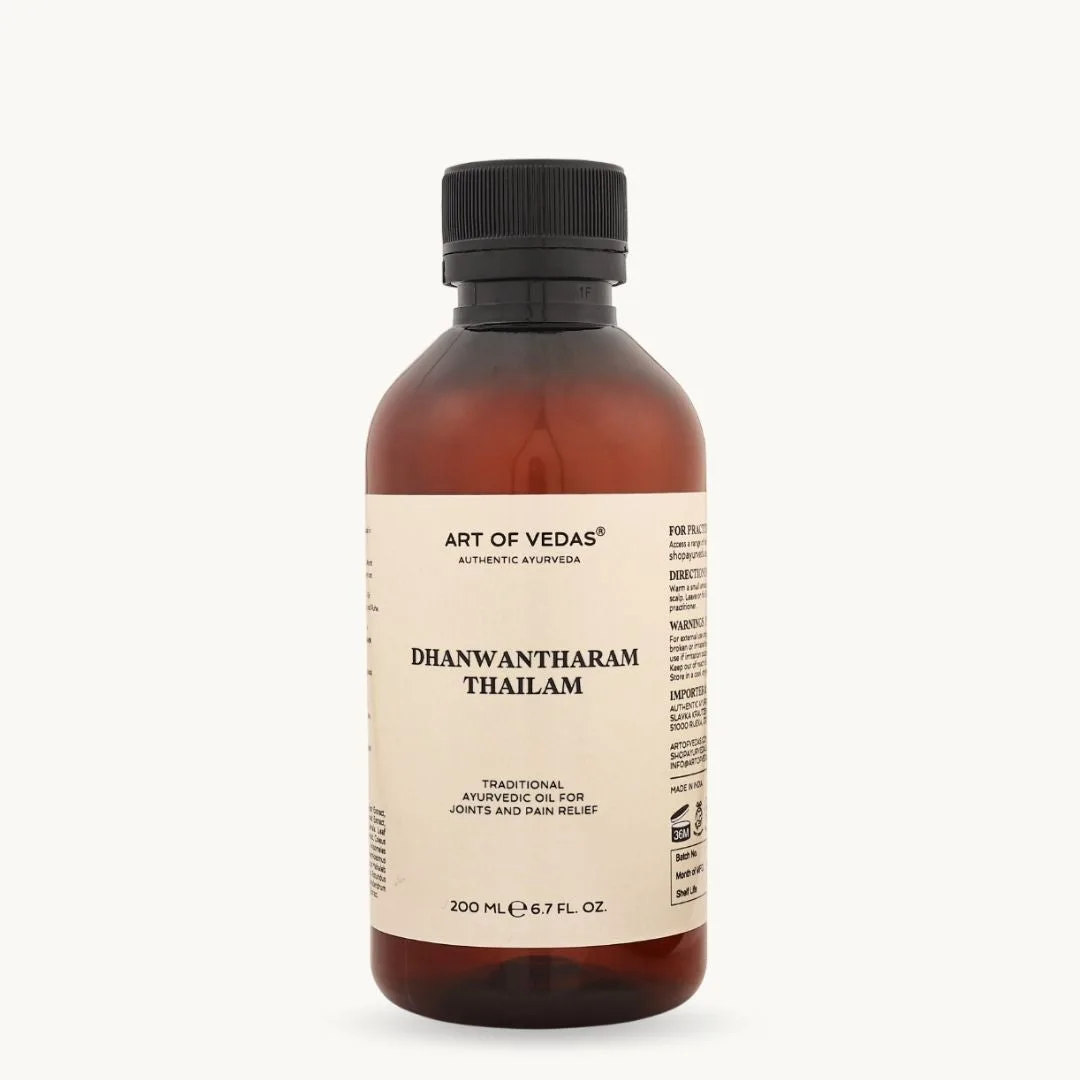
In our range the format is represented by the Dhanwantharam Mezhukupakam in the 450 ml size, the celebrated Bala-based Vata formula carried to its densest classical consistency. The same lineage stands behind the Dhanwantharam Kuzhambu, and the family as a whole, Thailam, Kuzhambu, Mezhukupakam, 101 Avartana and Ghritham, is mapped in our guide to the Dhanwantharam formats. Readers curious about the most intensively processed member of that family will find the drops explained in our Dhanwantharam 101 Avartana guide.
Using a Mezhukupakam
Take a small quantity from the jar with a clean, dry spoon or fingertip, let it soften between warm hands, and work it into the chosen area with slow, deliberate strokes. The format shares the Kuzhambu's temperament, only more so: it stays precisely where it is placed and absorbs gradually, which suits it to small regions that ask for sustained attention.
- Firm body allows precise, economical application
- Softens on contact with warm skin
- Remains on the applied area, absorbing slowly
- Suited to small, targeted regions rather than broad coverage
- A concentrated format: a little serves a full application
Frequently Asked Questions
Does a Mezhukupakam contain added thickeners?
No. The dense consistency comes from the natural proportion of the base fats and the extended classical reduction, nothing else.
Is a Mezhukupakam the same as a Kuzhambu?
They are neighbours on the same spectrum. The Kuzhambu is semi-solid and soft; the Mezhukupakam is carried further and holds a firmer body.
Should it be warmed before use?
Usually the warmth of the hands is enough. In a cold room, a brief, gentle water bath may help; it should never be made hot.
Is it applied to the whole body?
No. Like the Kuzhambu, the Mezhukupakam is a format for targeted, local application on chosen areas.
How should the jar be kept?
Closed, cool and dry, away from direct sunlight, and always approached with clean, dry hands or a spoon. Its firmness will vary a little with room temperature; this is normal.
This article describes traditional Ayurvedic practices for external use and is intended for general information only. It does not constitute medical advice. Please consult a qualified Ayurvedic practitioner or your medical professional before beginning a new routine, and perform a patch test before first use.