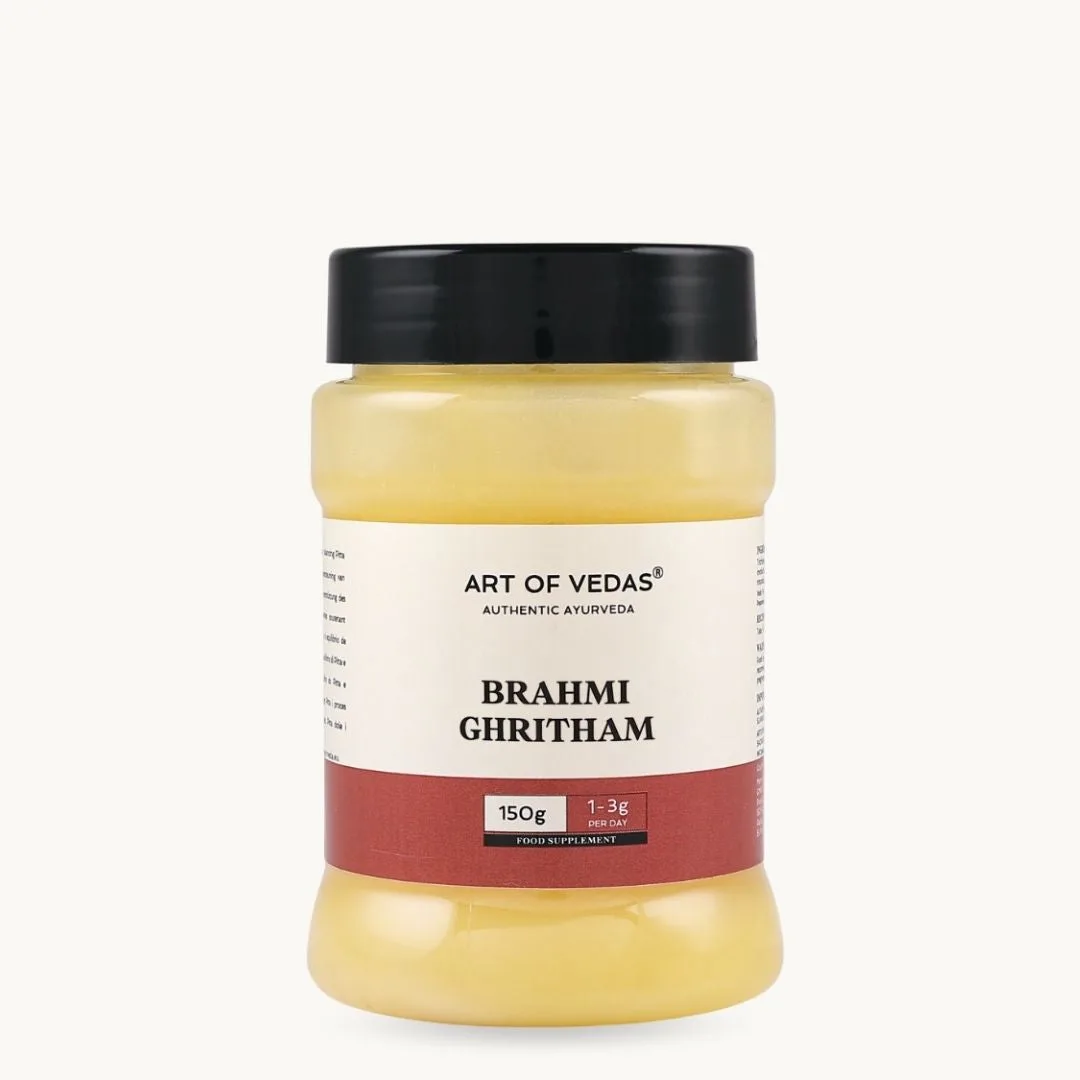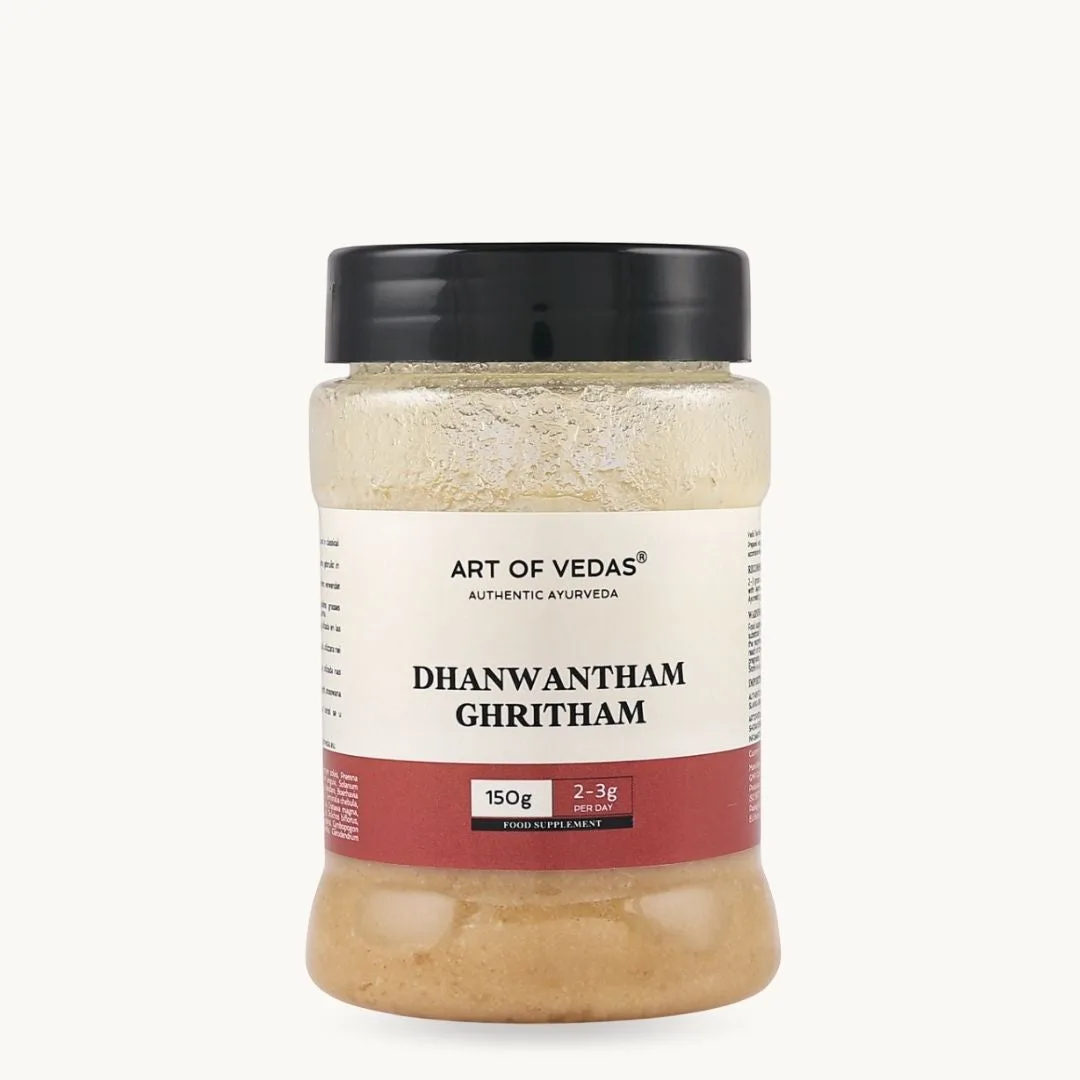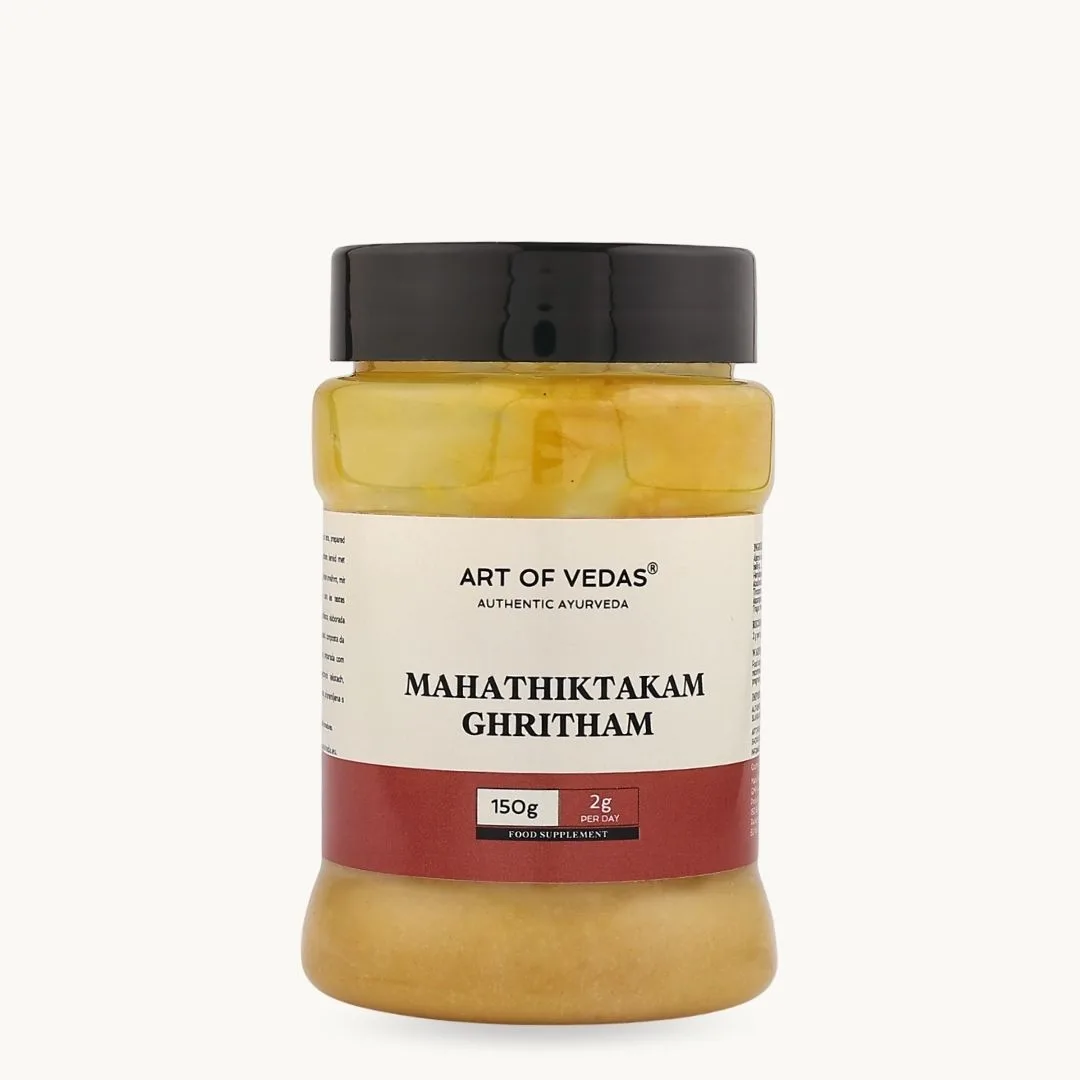
In brief: A jar of Ghritham is judged by its aroma, its behaviour at room temperature and what its label is willing to declare, not by its price.
The jar that looks different every month
A Ghritham (medicated ghee, a classical Ayurvedic preparation in which herbs are slowly cooked into a ghee base) bought in November often arrives pale, dense and faintly grainy. The same jar in July can be clear and almost pourable. Both states are correct. Ghee softens and re-sets across a narrow band of room temperature that European homes cross twice a year, so a crystalline surface after a cool night is only the fat finding its structure.
An oil looks much the same in any kitchen. A Ghritham does not, which is why the usual visual shortcuts fail and a first jar is so often mistaken for a spoiled one.
What you are actually paying for
A Ghritham is not herbs stirred into ghee. The classical method builds it in layers: a Kashayam (water decoction of the herbs) is prepared, a paste of the same or related herbs is ground, and both are cooked with the ghee over low heat for many hours until every trace of water has gone. What remains is a fat that carries the qualities of the herbs rather than merely containing them.
Two things follow. A large volume of decoction reduces to a modest quantity of finished preparation, so a jar stands for far more raw material than its weight suggests. The long cooking is also where quality is won or lost: stopped early, a preparation keeps moisture, and moisture shortens the life of the jar.
The Charaka Samhita discusses Sneha, the oleation practices, at length and places ghee first among the fats used for them, the carrier the tradition considers best suited to Pitta (the Dosha, or functional principle, governing heat and metabolism). Classical practice ties any Ghritham to Agni (digestive capacity), so traditional guidance concerns timing and quantity, not a fixed dose. A Ghritham is a dairy preparation and is not suitable for anyone avoiding dairy.
Four preparations, and what separates them
Brahmi Ghritham belongs to the Medhya group, one of the classical categories by which the tradition sorts its preparations. Brahmi is also sold as a Churnam (herbal powder), and our guide to Brahmi sets out the difference between the two forms.
Dhanwantharam Ghritham carries the Dhanwantharam formula into a ghee base and is classically associated in Ayurveda with Vata (the Dosha of movement, dryness and air). The same name also appears as a Thailam used externally for Abhyanga (Ayurvedic oil massage); the base, not the herb list, decides how each is used.
Thikthakam Ghritham is built on Tikta, the bitter taste, which the tradition directs towards Pitta. Mahathiktakam Ghritham is the larger formula in the same family, with a longer herb list and a stronger bitterness. Neither is a pleasant spoonful, and that is expected.
Triphala Ghritham sets the three fruits in a ghee base rather than the powder most people meet first, and that change of base is the whole of the difference. Our Triphala guide compares the forms.
Reading the label before you buy
Most of what can be known about a jar is decided before it reaches you, so the label is the first test. A supplier who prints little is telling you something. Look for:
- The full Sanskrit name of the preparation, not a marketing name such as "brain ghee" or "bitter ghee".
- A batch number and a best before date, printed on the jar rather than on a sticker that can be swapped.
- Net weight in grams, since the volume of a Ghritham changes with temperature and a figure in millilitres suggests the seller has not thought about it.
- The complete ingredient declaration, in a European language you read.
- The name and address of the business responsible for the product in the European Union, the party that answers to a regulator.
- A clear statement of whether the jar is sold as a food product or for external use. Some are offered in Europe for external use only, a legal position rather than a comment on the formula.
Aroma, colour and the warm spoon
Once the jar is open, aroma does most of the work. A sound Ghritham smells of its herbs over a soft dairy background. What should concern you is a sour or fermented note, a musty cellar smell, or the flat waxy smell of fat that has aged badly, none of them subtle once met.
Colour tells you less than people expect, because it belongs to the formula rather than the quality. The bitter preparations run dark, greenish or olive brown, while Brahmi Ghritham is usually a soft green. A pale cream Ghritham claiming a long bitter herb list is worth a question.
Then the warm spoon: take a little on a dry spoon and warm it. It should clear as it melts, and a trace of fine sediment is not a fault. Cloudiness that will not clear, or beads of water anywhere, points to a preparation that was not cooked to completion. Water is the one thing a Ghritham cannot tolerate.
Where Europeans buy it, and the trade-offs
A specialist retailer holding stock inside the European Union
The straightforward route for most buyers. You are billed in your own market's currency, the labelling has already been brought into European form, and European consumer rules on returns apply. Stock held inside the Union reaches an address in the Union with nothing collected at the door. Europe is not one customs territory, though: an address in the United Kingdom or Switzerland sits behind a customs border. Art of Vedas holds its Ghritham stock within the Union for these reasons, and because ghee dislikes long warm transits.
Ordering directly from outside the Union
The headline price is lower and the true cost usually is not. The label may not meet European requirements, a jar that has spent weeks in a hot container arrives softened and re-set, and if something is wrong there is rarely a remedy.
Buying for a clinic or a centre
Practices buy differently: batch consistency across a course of therapies matters more than the price of one jar. Our notes on wholesale supply for European practitioners cover pack sizes, lead times and the documentation a practice should keep on file.
Storing it once it arrives
A cool, dark cupboard is right. Refrigeration is unnecessary and makes the jar awkward to work with, since a chilled Ghritham must be warmed before it can be measured. Keep the jar closed, use a dry spoon every time, and never return an unused portion.
Questions buyers ask
Is Ghritham the same as the ghee sold in a supermarket?
No. Supermarket ghee is a cooking fat, priced and sold by the kilo. A Ghritham uses ghee only as its carrier and is taken in the small quantities classical practice describes. Heating one to cooking temperature would undo the slow work that put the herbs into the fat.
My Ghritham has gone grainy. Has it spoiled?
Almost certainly not. Slow cooling crystallises the fat, which is what a European home does to a jar between autumn and spring. Aroma decides it, not texture: sour or musty and the jar is finished, herbal and it is sound. Warming it gently in your hands evens the texture again.
Do I have to pay customs charges when buying Ghritham in Europe?
Two things decide it: where the jar is held and where it is going. If both are inside the European Union, nothing is collected. If either sits outside, as with a United Kingdom or Swiss delivery address, or stock shipped in from abroad, import VAT and usually a carrier handling fee fall due before delivery.
How long does a jar last once opened?
Several months, provided no water reaches it. The best before date assumes an unopened jar, so after opening the practical limits are a dry spoon, a tight lid and a cupboard away from the cooker.
Can I use a Ghritham and an Ayurvedic oil at the same time?
They are used differently, one internally where the label permits it and one on the skin. If you are following classical guidance for a set period, such as Panchakarma (the classical Ayurvedic purification sequence), timing matters, and that is a question for the practitioner supervising it.