This article provides educational information about classical Ayurvedic traditions. For any concerns about eye health, vision, or eye conditions, consult a qualified ophthalmologist or optometrist. The practices described here are general wellness practices and are not a substitute for professional eye care.
Ayurvedic Eye Care: Classical Netra Practices, Triphala Protocols and Modern Application
The eyes hold a specific and prominent place in classical Ayurvedic medicine. Ashtanga Hridayam Sutrasthana Chapter 16 - the chapter on Dinacharya (daily routine) - lists eye care as one of the practices to be performed regularly as part of maintaining sensory organ health. The Charaka Samhita Sutrasthana devotes specific sections to Netra Kriya (eye treatments), and Sushruta Samhita, whose author was also a surgical specialist, dedicates an entire section to the eye conditions and treatments of what he called Shalakya Tantra (head and sense organ medicine).
What the classical texts describe is a comprehensive approach to maintaining eye health through both internal and external practices. The internal practices address the systemic factors - Pitta (which governs vision and the eyes), Rakta Dhatu (blood quality), and the general vitality that sustains sensory function. The external practices address the eyes directly through specific preparations and procedures. Art of Vedas provides several of the preparations mentioned here. This guide covers the classical practices in practical terms, with clear guidance on what is appropriate for home use and what requires professional supervision.
The Ayurvedic Understanding of the Eyes
In classical Ayurveda, the eyes are governed primarily by Pitta, and specifically by Alochaka Pitta - the sub-dosha responsible for visual perception and the processing of light. The eye tissues themselves are classified as Tejas (fire element) in their fundamental composition, which is why the eyes are sensitive to excess heat, excess light, and to the state of Pitta throughout the body.
The Ashtanga Hridayam Uttarasthana's Shalakya chapter describes the eye as having five layers corresponding to the five elements, and the conditions affecting each layer as requiring different treatments. This anatomical precision - unusual in classical medical systems of the same era - reflects the particular attention given to the eye in Ayurvedic scholarship.
In contemporary terms, the most common eye presentations that respond well to classical Ayurvedic practices are: digital eye strain from prolonged screen use, dry and tired eyes from insufficient sleep or dry environments, sensitivity to bright light (a Pitta presentation), and the mild deterioration of vision quality associated with general tissue depletion or aging.
Tarpaka Kapha and Eye Moisture
While the eyes are primarily governed by Pitta, the moisture and lubrication of the eye is maintained by Tarpaka Kapha - the sub-dosha that nourishes and lubricates the sense organs, residing primarily in the head region. When Tarpaka Kapha is reduced - through excessive mental work, prolonged screen use, dry environments, poor sleep, or the natural reduction of Kapha with age - the eyes become dry, tired, and sensitive. The classical treatment for dry, tired eyes addresses both the excess Pitta that creates sensitivity and the reduced Tarpaka Kapha that reduces lubrication.
Classical Eye Care Practices for Home Use
Netra Basti (eye ghee pooling)
Netra Basti is the classical clinical treatment for the eyes, in which pure ghee (clarified butter) is pooled directly over the open eye within a dough ring for a sustained period. This is described in Ashtanga Hridayam Chikitsasthana as a primary treatment for eye strain, visual fatigue, and dryness. It requires professional supervision and is not a home practice. It is mentioned here for completeness and because many readers encounter the term and are curious about what it actually involves.
Anjana (eye applications)
Anjana is the classical practice of applying preparations to the inner eyelid margin. Various preparations are described in the classical texts, including Triphala-based preparations for general maintenance and more specific medicated Anjanas for particular eye conditions. Rasanjana (an extract of Berberis aristata) is among the most cited classical Anjana preparations for general eye health maintenance. These applications require professional guidance as they are applied at the eyelid margin and the preparation quality and application technique are critical to safety.
Triphala eye wash
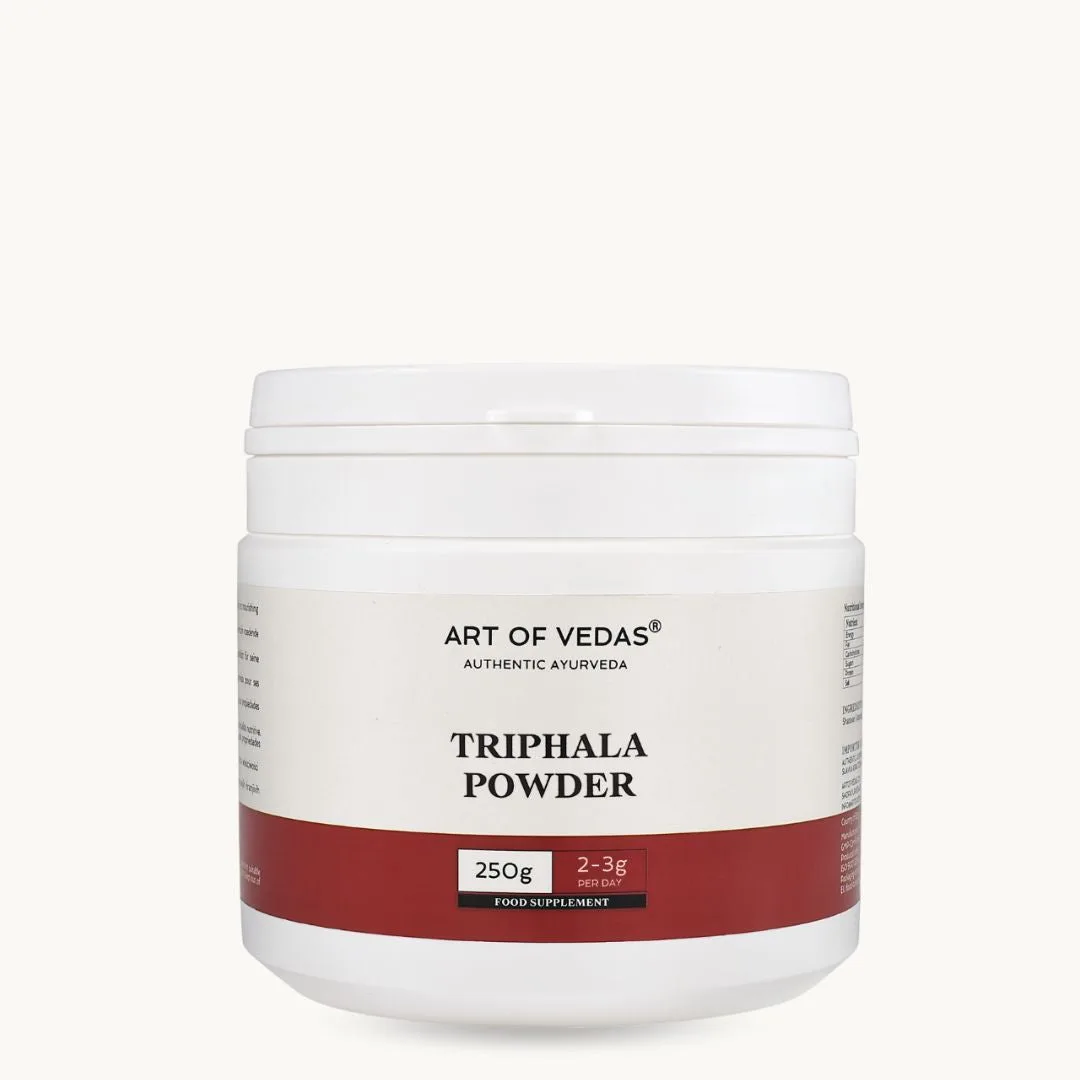
The most widely accessible home practice from the classical eye care tradition is the Triphala eye wash. Triphala churna (the powder of the three fruits: Amalaki, Haritaki, and Bibhitaki) is steeped in water overnight, filtered carefully through multiple layers of fine cloth to remove all solid particles, and used as a gentle eye wash in the morning. The Ashtanga Hridayam describes Triphala as specifically beneficial for the eyes, citing its action on Pitta and its cleansing of the ocular surface.
This practice requires that the Triphala water be filtered with exceptional care - any solid particle reaching the eye is irritating. Use a fine cotton cloth folded four times minimum as the filter, and allow the water to settle for several minutes after filtering before use. The filtered water should be at room temperature, not cold or warm. The eyes are washed with clean hands or using a sterile eye bath. The Triphala churna and Ghritham preparations are available from the Art of Vedas supplements collection.
Ghee application
Application of a small amount of pure ghee to the inner corners of the eyes and to the eyelids before sleep is a simple classical practice for maintaining Tarpaka Kapha and preventing dryness. The Charaka Samhita Sutrasthana describes this as part of Dinacharya and as specifically preventive of eye fatigue and Vata-type eye conditions. Use only pure, high-quality ghee prepared from. The application is external only - to the eyelid and corner of the eye, not to the eye surface itself.
Triphala Ghritham: The Classical Preparation for Eye Health
Triphala Ghritham is a classical medicated ghee prepared by processing ghee with a decoction of Triphala and specific complementary herbs using the classical Ghritham preparation method (Ghrita Paka Vidhi). It is described in Ashtanga Hridayam and Sahasrayogam as a primary preparation for eye health, specifically indicated for visual fatigue, eye strain, and the maintenance of healthy vision. It is taken internally as a Rasayana preparation, not applied externally to the eye.
The classical dosage is taken on an empty stomach in the morning with warm water. As a Ghritham preparation, it is the fat-based vehicle that carries the Triphala's active compounds into the deep tissues, making it more effective for tissue nourishment than the churna (powder) alone. For general eye health maintenance and internal Pitta management, Triphala Ghritham is among the most specifically classical preparations available.
The Role of Nasya in Eye Care
Nasya - the classical practice of applying medicated oil or ghee to the nasal passages - has a specifically described relationship with eye health in the classical texts. The Ashtanga Hridayam Sutrasthana explains that the nasal passages are connected to the channels supplying the eyes and the head (Urdhvanga), and that regular Nasya maintains the health of all sense organs in the head region, including the eyes.
The Nasya practice described in the classical Dinacharya involves applying two drops of medicated Nasya oil (such as Anu Thailam) to each nostril in the morning after brushing the teeth. This is one of the most consistently described Dinacharya practices across Charaka Samhita, Ashtanga Hridayam, and Sushruta Samhita. For the complete Nasya protocol, see the Nasya guide.
Dietary and Lifestyle Factors for Eye Health
The Ashtanga Hridayam Sutrasthana Dinacharya chapter lists specific activities that are harmful to the eyes: staring at small or bright objects for prolonged periods, reading in poor light, reading while lying down, excessive weeping, suppression of the urge to weep, exposure to smoke and fine dust, excessive sun exposure, and over-exertion. The modern equivalent of several of these - prolonged screen use, dry indoor environments with heating or air conditioning, and sleep deprivation - produces the same Alochaka Pitta disturbance and Tarpaka Kapha reduction that the classical texts describe.
The practical implication is straightforward: adequate sleep, reduction of prolonged screen time with regular breaks (the classical Tratak practice of candle gazing is described as an exercise for the eye muscles that can be used as a break from screen work), and protection from wind and dry air are the lifestyle foundations of classical eye care.
Internally, the Pitta-reducing diet described in the Pitta imbalance guide supports Alochaka Pitta and therefore eye health. Cooling foods, ghee, and adequate hydration maintain the moisture and quality of the ocular tissues. Vitamin A-rich foods (classified as Pitta-cooling and eye-nourishing in Ayurvedic dietary texts) are specifically cited in Ashtanga Hridayam as beneficial for vision maintenance.
Frequently Asked Questions
Can the Triphala eye wash improve vision?
The classical texts describe Triphala as beneficial for maintaining eye health and preventing the progression of eye fatigue and Pitta-type eye conditions. They do not describe it as correcting refractive errors or conditions requiring medical intervention. The practice is most accurately described as a general maintenance and preventive practice consistent with the Dinacharya tradition, not as a treatment for specific eye conditions. For any concerns about vision or eye health, an ophthalmologist's assessment is always the appropriate first step.
How often should the Triphala eye wash be done?
The classical Dinacharya texts describe eye care practices as part of the morning routine - daily or several times weekly depending on the individual's susceptibility and the season. Daily Triphala eye wash is described in some classical texts as appropriate for regular maintenance, particularly in summer (the Pitta season) when the eyes are more susceptible to heat-related strain. In practice, three to four times per week is sufficient for most people in temperate European climates.
Is it safe to apply ghee to the eyes?
Pure ghee applied externally to the eyelids and the inner corners of the eye (the canthi) is described as safe in the classical texts and is consistent with the general principle that pure ghee is a mild and nourishing substance. The application is not to the eye surface but to the surrounding skin and the eyelid margins. Netra Basti, in which ghee is pooled over the open eye, is a professional clinical treatment and is not described as a home practice. Any application of any substance directly to the eye surface should be discussed with an eye care professional.
Can children do the Triphala eye wash?
The classical texts describe Anjana and Netra care practices as appropriate for children within the Kaumarabhritya tradition. The Triphala eye wash, if the preparation is carefully filtered and at body temperature, can be appropriate for children under adult supervision. The key safety requirement is thorough filtering of all solid particles from the Triphala water before use.