In brief: An Ayurvedic Dosha test is a questionnaire about your body, digestion, sleep, mind and habits over many years, which estimates your Prakriti: your personal proportion of Vata, Pitta and Kapha. Answer for how you have been most of your life, not how you feel this week, because a recent change shows your current state (Vikriti) instead. The result is a first guide for choosing food, routines and oils; a qualified practitioner confirms it with a consultation and pulse reading. Take the free Art of Vedas Dosha test in a few minutes.
This article is part of our How to Find Your Dosha Type: What the Classical Texts Actually Assess guide series.
Every person carries a unique proportion of the three Doshas - Vata, Pitta, and Kapha - that shapes how the body functions, how the mind processes experience, and how the individual responds to food, seasons, stress, and environment. This unique proportion is your Prakriti - your Ayurvedic birth constitution - and understanding it is the first step toward applying Ayurveda's practical wisdom to your daily life.
Our free Dosha test provides an initial assessment of your dominant constitutional tendencies. It is designed to help you begin recognising patterns - the physical, digestive, and psychological characteristics that classical Ayurvedic texts associate with each Dosha - and to orient you toward the dietary, lifestyle, and self-care practices most likely to support your particular constitution.
Before You Begin: How to Get Accurate Results
The accuracy of any self-assessment quiz depends on how you answer. These guidelines will help you get the most useful results:
Answer based on your lifelong tendencies, not just your current state. The quiz is designed to indicate your Prakriti - your constitutional baseline - rather than your Vikriti (current imbalance). When answering, think about how you have been throughout your life, not only how you are feeling this week. If a question asks about your body frame, answer based on your natural frame - not your current weight, which may be influenced by recent diet, stress, or lifestyle changes.
If two answers seem equally true, choose both. Dual-Dosha constitutions (Vata-Pitta, Pitta-Kapha, Vata-Kapha) are the most common constitutional type. If you consistently find yourself split between two Doshas, this is meaningful - it likely reflects a genuine dual constitution rather than indecision.
Do not try to achieve a particular result. There is no "best" Dosha type. Each constitution has distinctive strengths and characteristic challenges. The purpose of the test is accurate self-recognition, not aspiration.
Take the test in a calm state. Stress, feeling unwell, extreme weather, travel, and strong emotions all temporarily shift your Dosha balance and can influence your answers toward Vikriti rather than Prakriti.
Understanding Your Results
If Your Dominant Dosha Is Vata
Vata constitutions are characterised by lightness, mobility, creativity, quick thinking, and sensitivity. Your strengths include adaptability, enthusiasm, and the ability to learn quickly. Your challenges tend toward dryness, irregular digestion, difficulty maintaining weight, light sleep, and a tendency toward worry during stressful periods.
Your priority practices: Warm oil self-massage (Abhyanga) with sesame-based oils - the single most important daily practice for Vata constitutions. A regular daily routine with consistent meal times, sleep times, and practices. Warm, cooked, nourishing food - emphasising sweet, sour, and salty tastes. Warmth in every form - warm food, warm oil, warm baths, warm clothing. Reduced sensory stimulation and deliberate periods of quiet.
If Your Dominant Dosha Is Pitta
Pitta constitutions are characterised by sharpness, warmth, determination, strong digestion, and natural leadership. Your strengths include focused intellect, courage, and the capacity for sustained, disciplined effort. Your challenges tend toward heat, sensitivity to warm weather, excess acidity, irritability, and a driven quality that can lead to burnout.
Your priority practices: Cooling dietary emphasis - sweet, bitter, and astringent foods, avoiding excess spice, alcohol, and sour or fermented foods. Abhyanga with coconut oil or cooling Thailams. Deliberate moderation of intensity - building rest into your schedule rather than waiting for exhaustion. Time in nature, particularly near water. Avoiding eating when emotionally heated. Protecting the eyes and skin from excessive heat and sun.
If Your Dominant Dosha Is Kapha
Kapha constitutions are characterised by strength, endurance, stability, patience, and deep compassion. Your strengths include physical resilience, excellent long-term memory, emotional steadiness, and the capacity for sustained, loyal commitment. Your challenges tend toward heaviness, sluggish digestion, weight accumulation, congestion, and a resistance to change that can become stagnation.
Your priority practices: Regular vigorous exercise - the single most important practice for Kapha constitutions. Lighter, warmer, drier food - emphasising pungent, bitter, and astringent tastes. Eating only when genuinely hungry. Stimulating morning routine - rising before 6 AM, dry brushing, lighter Abhyanga. Variety and new experiences to counteract Kapha's tendency toward routine-as-stagnation.
If You Are a Dual Dosha Type
Most people are. A Vata-Pitta result means both Doshas are prominent in your constitution, and your approach needs to balance both - nourishing enough for Vata without overheating for Pitta, structured enough for Vata without being too rigid for Pitta's need for intensity. The Ayurvedic diet guide covers dual-Dosha dietary strategies, and the individual Vata, Pitta, and Kapha guides provide the detailed understanding of each Dosha that helps you navigate the dual-Dosha balance.
The Limits of Self-Assessment
This test is a compass, not a map. It provides directional guidance - a first indication of your dominant constitutional tendencies - but it cannot achieve the precision of a clinical assessment. The Prakriti-Vikriti distinction - understanding what is your permanent constitution versus what is your temporary imbalance - requires the depth of assessment that only a trained practitioner can provide.
Classical Ayurvedic constitution assessment uses pulse reading (Nadi Pariksha), tongue analysis, detailed history-taking, and physical observation - methods developed over millennia precisely because questionnaires alone cannot capture the full picture. An online quiz cannot read your pulse, observe the subtle qualities of your tongue coating, or assess the specific interaction between your Prakriti and your current Vikriti that determines which practices will be most effective for you specifically.
Your Next Step
Use your test results to begin exploring: read the guide for your dominant Dosha type, start applying the basic dietary and lifestyle recommendations, and notice how your body responds. This experiential foundation - observing the patterns in your own body through the lens of Dosha awareness - is genuinely valuable and prepares you for the deeper understanding that clinical assessment provides.
When you are ready to move beyond self-assessment to a precise, personalised constitutional evaluation, an Ayurvedic consultation with one of our AYUSH-certified Ayurvedic doctors provides:
A clinical Prakriti (birth constitution) assessment. A current Vikriti (active imbalance) assessment. Personalised dietary recommendations. A tailored Dinacharya daily routine. Specific oil and product recommendations. Herbal and supplement guidance matched to your individual pattern.
The journey from general Dosha awareness to personalised Ayurvedic living begins with curiosity and a willingness to observe. This test is your starting point.
Dosha Types: The Three Doshas in Brief
The Dosha theory is set out in the Charaka Samhita, Sutrasthana 1, as the foundation for understanding individual difference. Every person carries all three Doshas, Vata, Pitta and Kapha, in a proportion of their own, and that proportion shapes the baseline of body and mind. The different Dosha types are easiest to recognise through their elements and qualities:
- Vata, the force of movement: air and space (ether). It governs every movement in body and mind, from breath and nerve impulses to the movement of food and of thoughts. Qualities: light, dry, cold, mobile, rough and subtle.
- Pitta, the force of transformation: fire and water. It governs digestion, metabolism, perception and the processing of food and experience. Qualities: hot, sharp, slightly oily and mobile.
- Kapha, the force of structure and cohesion: earth and water. It governs structure, lubrication, stability and natural resilience. Qualities: heavy, slow, cool, smooth, soft and stable.
Prakriti and Vikriti in a Dosha Assessment
Prakriti, your birth constitution, is fixed and defines the state in which you feel and function best. Vikriti, your current state, moves with diet, lifestyle, season and stress. A complete assessment reads both. If your Prakriti is mainly Pitta but overwork, travel and irregular meals have raised Vata, the immediate advice addresses the Vata Vikriti, while the longer-term routine keeps the balance that suits your Pitta Prakriti.
Many simplified quizzes ask only about current experience and so capture Vikriti rather than Prakriti. A useful questionnaire asks about stable lifelong traits for the Prakriti questions and about the past few months for the Vikriti questions. Avoid answering from a particularly good or bad recent period, and answer as you are rather than as you would like to be.
What a Classical Dosha Assessment Evaluates
In classical practice the full assessment is the Ashtavidha Pariksha described in the Ashtanga Hridayam: an eight-fold examination of pulse, tongue, eyes, skin, urine, stool, voice and overall appearance, carried out by a trained practitioner. Classical Prakriti Pariksha, the constitutional examination, adds detailed questioning and observation. Ayurvedic tests that work by questionnaire cannot replicate this; they cover the areas most open to self-observation.
The ten areas of a self-assessment
A well-built Dosha questionnaire covers body frame and build, skin texture, hair, appetite and eating patterns, sleep, emotional responses to stress, memory and thinking style, speech and communication, energy and stamina, and sensitivity to climate. How extensive an Ayurvedic Dosha test needs to be follows from this list: fewer areas give a rougher picture.
How each Dosha shows in the answers
- Build: Vata slender with prominent joints; Pitta medium and athletic; Kapha broader and heavier with natural endurance. Answer for your lifelong frame, not your current weight.
- Skin and hair: Vata skin dry, thin and prone to roughness; Pitta skin warm, prone to redness and heat-sensitive; Kapha skin thicker and oilier.
- Digestion: variable digestion with bloating and gas points to Vata (Vishama Agni); sharp digestion with strong appetite and acidity to Pitta (Tikshna Agni); slow, steady digestion with a stable appetite to Kapha (Manda Agni). Digestion is among the most reliable indicators in classical assessment.
- Sleep: Vata sleeps lightly and wakes easily; Pitta sleeps intensely but may wake in the night feeling warm or mentally busy; Kapha sleeps deeply and wakes with difficulty.
- Mind under stress: Vata tends towards fear and worry, Pitta towards anger and criticism, Kapha towards withdrawal and emotional heaviness.
Is My Dosha Result Correct? Dual, Tridoshic and Changing Results
A self-assessment based on lifelong patterns should give a broadly consistent result each time. If it shifts noticeably between tests, either you have a dual-Dosha constitution or your Vikriti differs clearly from your baseline; a qualified practitioner can separate the two. Besides single-Dosha and dual types, the classical texts describe the rare Tridoshic type. In European practice the Vata-Pitta type is the dual constitution met most often.
A Tridoshic result, all three roughly equal, is uncommon. Tridoshic people tend to be robust but also the most sensitive to seasonal shifts, because each season raises a different Dosha. The classical aim is never equal amounts of all three, but the proportion that is right for your own Prakriti through each season and stage of life.
From Dosha Test Result to Oils and Daily Care
Vata result
The priority is warmth, nourishment and regularity. Dhanwantharam Thailam is the foundational daily Abhyanga oil, with Mahamasha Thailam where the muscles feel depleted, Ksheerabala Thailam when Vata concerns the nervous system, and Mahanarayana Thailam for broad Vata support. The Vata Dosha Massage Oil is a practical start for those new to Abhyanga, and Nasya with Anu Thailam is the classical daily practice for Prana Vata.
Pitta result
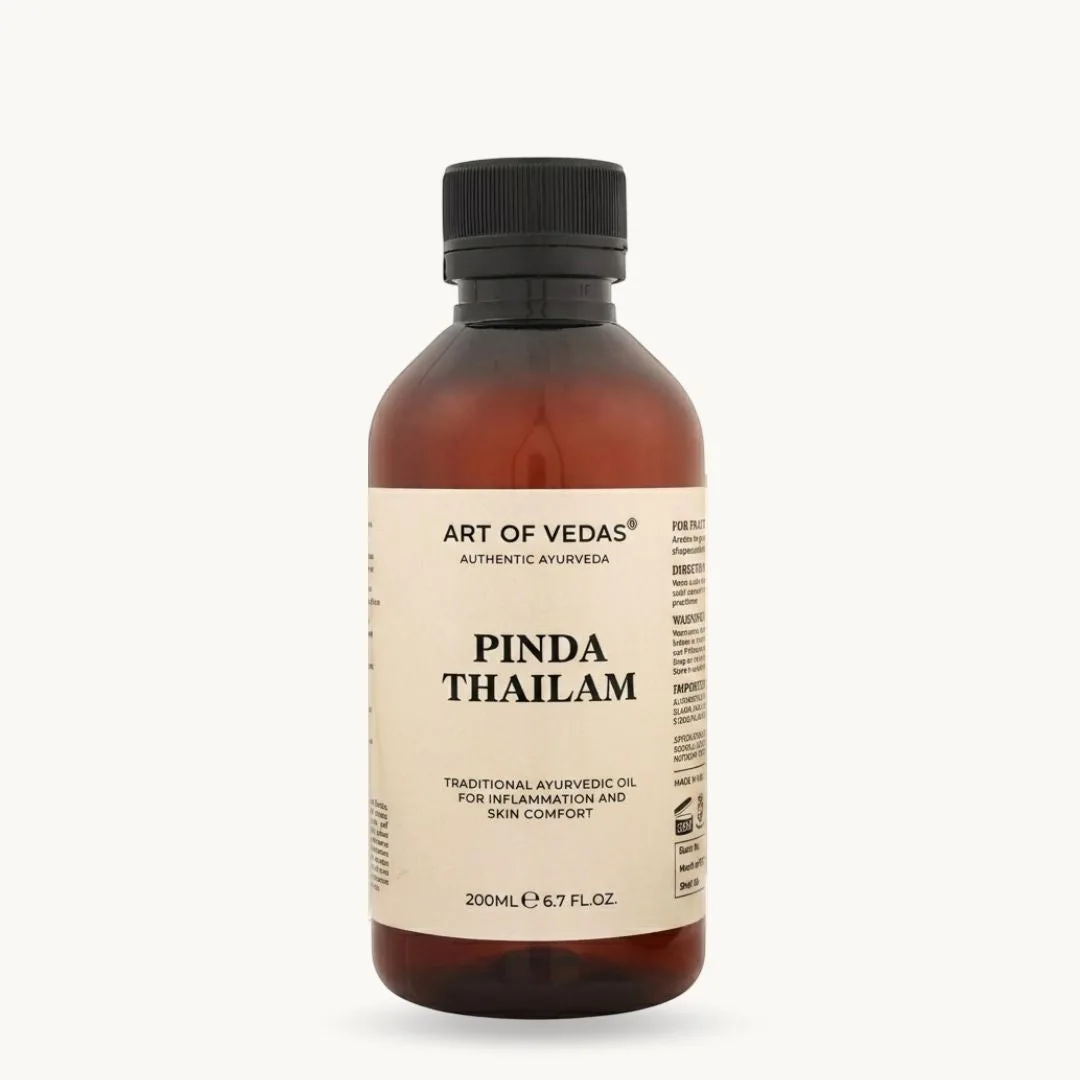
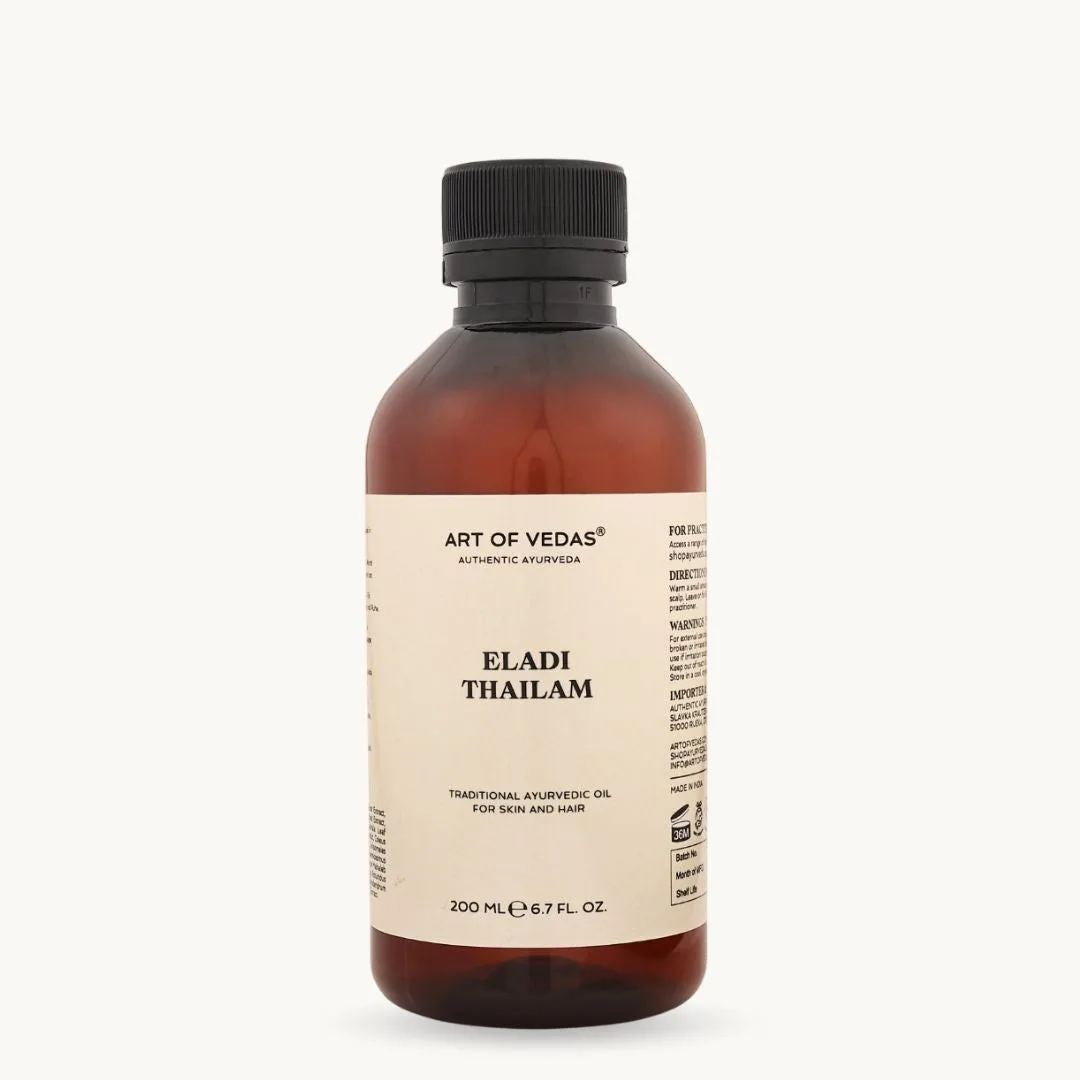
The priority is cooling and moderation. Pinda Thailam and Ksheerabala Thailam, which is cooling yet Vata-pacifying, are traditionally chosen for Pitta-type heat in the skin. For the face, Eladi Thailam is a classical face oil built around cooling herbs in a coconut base, traditionally suited to Pitta-type skin.
Kapha result
The priority is stimulation, lightness and movement: warmer, lighter oils in smaller amounts, applied with a vigorous technique and a shorter contact time. Kansa tools such as the Kansa Vatki suit this brisk style of Abhyanga.
Every result: copper tongue scraper and copper glass
Classical oral care and copper vessel practices are described as suitable for all constitutions. The copper tongue scraper and the copper glass for morning water are both called Tridoshahara, appropriate for every Dosha, which makes them the simplest entry point into Dinacharya whatever your result.
Using the Art of Vedas Dosha Test
The English Art of Vedas Dosha test for Ayurveda is free and takes one sitting of about five minutes. It covers body type, skin, digestion, sleep, mental patterns and stress responses, and keeps the Prakriti and Vikriti questions apart. Results show a breakdown of your relative Dosha proportions and, where it differs from your baseline, an indication of your current Vikriti. Retake it with the seasons or after a major life change to follow how your Vikriti moves; your Prakriti will stay the same.
Where Dosha Theory Comes From
What is Nadi Pariksha in Ayurveda? Nadi Pariksha is the classical Ayurvedic pulse reading. The practitioner places three fingers on the radial pulse at the wrist, the index finger reading Vata, the middle finger Pitta and the ring finger Kapha, and judges the rhythm, strength and character of the pulse. It is one of the eight examinations of the Ashtavidha Pariksha, the classical full assessment.
Can Nadi Pariksha be done online or by yourself? No. Nadi Pariksha needs a trained practitioner's fingers on the pulse, ideally in the morning before food, and years of practice to read. Online and self-assessment Dosha tests use questions instead; they give a first picture of your constitution, your Prakriti, but they do not replace a pulse reading in person by a qualified Ayurvedic practitioner.
How do I know my Dosha? To know your Dosha, start with a Dosha test that asks about lifelong traits: build, skin, digestion, sleep, temperament and how you respond to stress and climate. Answer for how you have been most of your life. The result estimates your Prakriti. A qualified Ayurvedic practitioner can confirm it with pulse reading, observation and a full conversation.
Can my Dosha type change over time? Your Prakriti, the Dosha type you are born with, does not change. Your Vikriti, the current state of your Doshas, changes constantly with diet, lifestyle, season and life events. That is why the same person may need different Ayurvedic routines at different times, and why retaking a Dosha test seasonally or after a big life change is useful.
What if I am Tridoshic, equal in all three Doshas? A Tridoshic constitution, with Vata, Pitta and Kapha roughly equal, is described in the classical texts as possible but rare. Tridoshic people tend to be robust yet especially sensitive to seasonal change, because each season raises a different Dosha. A near-equal test result can also reflect uncertain answers, so a practitioner's assessment is particularly useful here.
My Dosha test says I am Vata-Pitta. Which oils should I use? For a Vata-Pitta constitution the choice follows the season. In autumn and winter, the Vata season, warming oils such as Dhanwantharam Thailam or Mahanarayana Thailam are classically preferred. In summer, the Pitta season, Ksheerabala Thailam suits better, as it is cooling yet Vata-pacifying. Watch which Dosha is more raised at the time and adjust.
What is the difference between a Dosha test and a full Ayurvedic consultation? A Dosha test is a self-report questionnaire that gives a constitutional profile from what you observe in yourself. A full consultation with a qualified Ayurvedic practitioner adds Nadi Pariksha, direct examination and the classical Ashtavidha Pariksha, and can judge Dosha balance, tissue strength and channels in ways a questionnaire cannot. The test is a starting point; the consultation goes deeper.
Is a Dosha test a diagnosis? No. A Dosha test is an educational tool from the Ayurvedic tradition for understanding your constitution and guiding everyday choices in food, routine and oils. It does not diagnose any condition and does not replace professional care. During pregnancy, for children, while taking prescriptions or with any persistent complaint, ask a qualified practitioner or your doctor.
How does an Ayurveda Dosha test work? The test asks about stable traits: build, skin, hair, appetite, digestion, sleep, temperament, how you react to heat and cold and how you handle stress. Each answer points to Vata, Pitta or Kapha, and the totals give your dominant Dosha or Dosha pair. The Art of Vedas Dosha test is free and takes about five minutes.
How accurate is an online Dosha test? An online Dosha test gives a useful first picture, especially of your dominant Dosha, but it relies on self-observation. A classical assessment by a practitioner adds pulse reading (Nadi Pariksha), examination of the tongue, eyes and skin and a full conversation, and separates your constitution from your present state.
What do I do with my Dosha test result? Use it to choose your daily routine, your diet and your Abhyanga oil: warming and grounding for Vata, cooling for Pitta, light and stimulating for Kapha. Re-take the test after a few months, and ask a practitioner if the result surprises you or if you want personal advice.
The systematic framework of the three Doshas is described in the Charaka Samhita, Sutrasthana chapters 1, 17 and 20, and in the Ashtanga Hridayam, Sutrasthana chapters 1, 11 and 12. The classification of individual constitution by Dosha dominance, the Prakriti framework itself, is described in Charaka Samhita, Vimana Sthana 8. It is the classical basis for all constitutional assessment, including today's Dosha questionnaires.
The Dosha test provides a general indication of constitutional tendencies based on self-reported information. It is an educational tool and not a clinical assessment. For accurate constitutional determination and personalised health guidance, consult a qualified Ayurvedic practitioner or healthcare professional.