This article is part of our Eladi Thailam vs Kumkumadi Thailam: Which Classical Ayurvedic Face Oil Is Right for You? guide series.
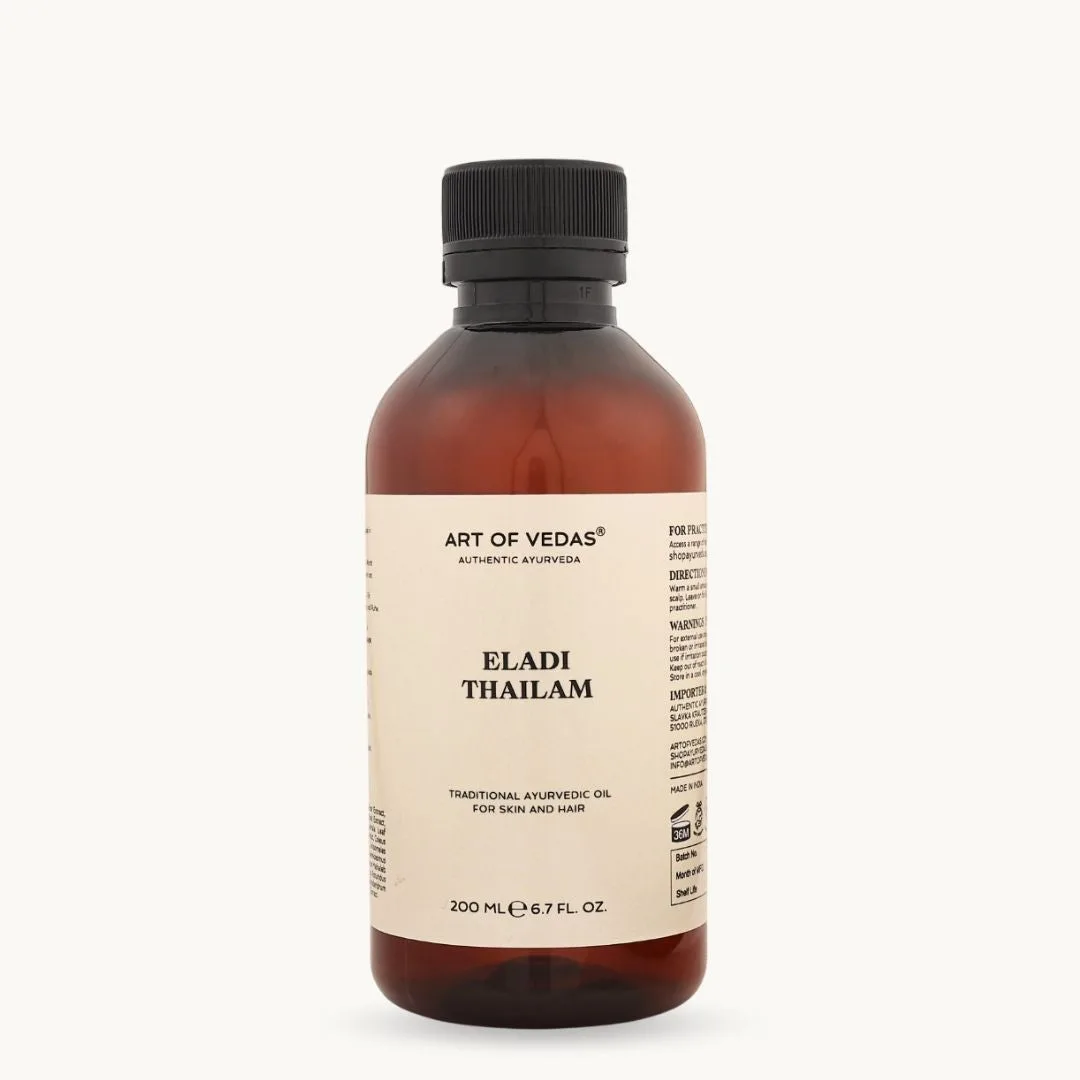
Important Disclaimer: Eladi Thailam is a traditional Ayurvedic wellness oil for external use only. It is not a medicine and does not treat, cure, or prevent any disease or medical condition. For any skin condition requiring medical attention, please consult a qualified healthcare professional. Explore authentic Eladi Thailam here.
Some formulas are invented. Others are discovered, refined over generations, and eventually written down in texts that codify centuries of accumulated observation.
Eladi Thailam belongs firmly in the second category.
This is a formula whose origins trace back at least 2,000 years - probably longer - to the physicians and scholar-practitioners who built the foundations of Ayurvedic medicine in ancient India. It was refined through centuries of practice in classical, where the great traditions of classical Ayurveda took root most deeply. It was documented in texts that were copied by hand, passed between teachers and students, and eventually printed and distributed across the world. And today, that same formula is prepared in essentially the same way, with essentially the same ingredients, that it was when it was first written down.
Understanding where Eladi Thailam comes from is not merely an exercise in historical curiosity. The formula's longevity is itself evidence of something important - that it worked well enough, for enough people, over enough time, to be worth preserving and transmitting across dozens of generations of Ayurvedic physicians. No formula survives two millennia in active clinical use by accident.
The World That Produced Eladi Thailam
Ayurvedic medicine - the "science of life" - emerged in the Indian subcontinent over many centuries, with its foundational texts composed roughly between 700 BCE and 700 CE. These texts - the Charaka Samhita, the Sushruta Samhita, and the Ashtanga Hridayam - represent the distilled medical knowledge of a sophisticated civilisation that had been systematically observing the relationship between plants, the human body, and health for centuries before the texts were written.
What distinguishes Ayurvedic medicine from many other ancient medical traditions is its philosophical depth. Ayurveda was not simply a collection of remedies - it was a complete system of thought, grounded in a coherent understanding of how the body works (the three dosha framework of vata, pitta, and kapha), how disease arises (imbalance between these forces and between the individual and their environment), and how wellness is maintained through daily practices, seasonal adjustments, diet, and targeted therapeutic interventions.
Within this system, medicated oils - Thailams - occupied a central therapeutic role. The classical texts are explicit about why: oil (particularly sesame oil) has a unique capacity to penetrate the skin and deeper tissues, to carry therapeutic compounds into the body, and to pacify vata - the dosha most associated with movement, dryness, depletion, and nervous system dysregulation. The detailed development of oil-based therapies, from simple daily Abhyanga (self-massage) to the complex multi-day Panchakarma treatments, reflects the depth of understanding that classical Ayurveda had developed around the therapeutic potential of medicated oils.
The Great Classical Texts and Their Relationship to Eladi
Charaka Samhita - The Physician's Compendium
The Charaka Samhita, attributed to the physician Charaka and revised by Dridhabala (roughly 1st century BCE to 1st century CE in its current form), is the foundational text of Kayachikitsa - internal medicine in Ayurveda. It is a massive work covering everything from fundamental philosophical principles to detailed treatments for specific conditions.
The Charaka Samhita is particularly important for understanding the theoretical framework within which Eladi Thailam was developed. Charaka's detailed analysis of skin conditions (classified under the broad category of kushtha), his descriptions of the properties of key herbs like haridra (turmeric), yashti madhu (licorice), and manjishtha (Indian madder), and his articulation of the principles of varnya therapy (supporting skin radiance and complexion) all provide the intellectual foundation upon which formulas like Eladi were later built.
Charaka's descriptions of the yogavahi property of sesame oil - its capacity to enhance the effect of whatever is combined with it - appear repeatedly across the text and remain central to understanding why Sneha Paka (medicated oil preparation) is such an important delivery system in Ayurvedic therapeutics.
Sushruta Samhita - The Surgeon's Compendium
The Sushruta Samhita, attributed to the physician Sushruta and considered among the oldest surgical texts in the world, complements the Charaka Samhita with its more surgical and dermatological focus. Sushruta's detailed taxonomy of skin conditions, his descriptions of wound healing, and his extensive materia medica of topical agents are particularly relevant to formulas like Eladi Thailam that target the skin specifically.
The Sushruta Samhita's section on Uttara Tantra contains detailed descriptions of eye, ear, nose, and skin treatments - the domains in which Eladi Thailam has traditionally been most used. Sushruta's observations about the properties of tuvaraka (Hydnocarpus laurifolia) in skin conditions, and his use of complex polyherbal oil formulas for skin wellness, point directly toward the formulation tradition that produced Eladi.
Ashtanga Hridayam - The Heart of Ayurveda
The Ashtanga Hridayam, composed by the physician Vagbhata (approximately 7th century CE), represents a synthesis of the earlier Charaka and Sushruta traditions into a more concise, structured compendium. It became one of the most widely used Ayurvedic reference texts and remains foundational in Ayurvedic education today.
Vagbhata's discussion of dinacharya (daily routine) - including the practice of daily Abhyanga with medicated oils - is particularly relevant to Eladi Thailam's traditional use. His chapter on Mukhabhyanga (facial oil massage) in the context of daily self-care rituals is among the earliest explicit descriptions of what we would today call a facial care routine, and it provides the classical framework for the daily application of oils like Eladi.
Sahasrayogam: The Primary Source for Eladi Thailam
While the great classical texts provide the theoretical foundation for Eladi Thailam, the formula itself is most directly documented in a different category of text - the regional formularies that compiled specific, tested preparations for practical clinical use.
Of these, the most important for understanding Eladi Thailam is the Sahasrayogam.
What Is the Sahasrayogam?
The Sahasrayogam (literally "a thousand formulas" or "a thousand combinations") is a classical Ayurvedic formulary from classical - a compilation of tested, practically applied preparations drawn from the broader classical tradition and refined through centuries of clinical practice. The text is typically attributed to compilation between approximately the 14th and 17th centuries CE, though many of the formulas it contains are considerably older.
The Sahasrayogam is organised into sections covering different preparation types and therapeutic categories. The Tailaprakarana (oil formulas section) is where Eladi Thailam appears, alongside dozens of other medicated oil preparations. What makes the Sahasrayogam particularly significant is that it provides the most complete classical specification for the formula - listing all ingredients with their quantities, describing the preparation method in detail, and specifying the therapeutic indications. This is why the Sahasrayogam remains the primary classical reference for Eladi Thailam to this day.
classical's Special Relationship with Ayurvedic Oil Formulas
The emergence of the Sahasrayogam from classical is not coincidental. classical developed what many scholars consider the most clinically sophisticated branch of classical Ayurvedic medicine, particularly in the domain of oil-based therapies.
Several factors contributed to this specialisation. classical's tropical climate, with its abundant coconut palms, naturally oriented local practitioners toward oil-based therapies. The isolation of classical - bounded by the Western Ghats mountains and the Arabian Sea - allowed local Ayurvedic traditions to develop along their own lines with less outside influence. And the patronage of classical's royal families, who supported Ayurvedic physicians and their hereditary knowledge lineages (the Ashtavaidya families), created conditions for sustained, multi-generational refinement of therapeutic practices.
The result was a tradition of extraordinary sophistication in Sneha Paka - medicated oil preparation. classical's Ayurvedic physicians developed detailed protocols for the preparation, testing, and clinical application of medicated oils that remain unmatched in their specificity and depth. Formulas like Eladi Thailam, developed and refined within this tradition, carry the accumulated clinical wisdom of many generations of careful, expert observation.
The Ashtavaidya Tradition and Eladi Thailam
Central to understanding how classical Ayurvedic formulas like Eladi Thailam were preserved and refined over centuries is the Ashtavaidya tradition - the system of eight hereditary physician families of classical who held and transmitted the most sophisticated Ayurvedic knowledge.
The word Ashtavaidya means "eight physicians" or "eight physician lineages" - referring to the eight brahmin families who were designated, during classical's medieval period, as the official custodians of Ayurvedic medical knowledge in the region. Each family held specific texts, specific therapeutic specialisations, and specific clinical responsibilities. The knowledge was transmitted within families - from father to son, from teacher to student - in a system designed to maintain the integrity and depth of the tradition across generations.
Within the Ashtavaidya families, the preparation of classical formulas was not a matter of following a recipe - it was a craft skill developed over years of apprenticeship alongside senior family members. The subtle judgements involved in Sneha Paka preparation (when to adjust the temperature, how to test for completion, how to judge the quality of raw materials) were transmitted experientially, not just textually. The Ashtavaidya families also maintained high standards for ingredient sourcing and quality - standards that ensured the formulas they prepared achieved the results their texts described.
The Sneha Paka Vidhi: A 2,000-Year-Old Pharmaceutical Method
The classical preparation method for Eladi Thailam - Sneha Paka Vidhi - is documented in detail in the Ashtanga Hridayam and has remained essentially unchanged for at least 1,500 years.
The Four Stages of Sneha Paka
Mridu Paka (Gentle/Soft Cook): The first stage, characterised by the oil being lightly infused but still fluid and light. Mridu Paka preparations are used for specific gentle therapeutic applications. The kalka (herb paste) at this stage is still soft and pliable.
Madhya Paka (Middle Cook): The optimal preparation stage for most therapeutic medicated oils, including Eladi Thailam. At Madhya Paka, the water has been fully driven off, the oil has become saturated with herbal compounds, and the kalka has become firmer and more waxy. This stage produces an oil with the full herbal saturation intended for therapeutic use.
Khara Paka (Hard Cook): The third stage, where the preparation has been cooked to a state that produces a firmer, more concentrated preparation - typically used for specific applications like medicated ghee.
Dagdha Paka (Burnt Cook): The stage that results from overcooking. This is the stage to avoid, and careful temperature management throughout the process is specifically aimed at preventing reaching Dagdha Paka.
For Eladi Thailam intended as a facial oil, the traditional Madhya Paka stage is the target - producing an oil richly infused with herbal compounds while remaining fluid and with its aromatic volatile compounds intact.
The Classical Tests for Preparation Quality
The kalka test (burning test): Take a small ball of the kalka from the preparation. Form it into a wick-like shape and attempt to burn it. If it burns cleanly and without crackling, the preparation is correctly complete - all water has been driven off. If it crackles, water remains and cooking must continue.
The wick test (varti test): Form the kalka into a thin wick shape. If it maintains its form without crumbling, the preparation has reached the correct consistency.
The vision test: The oil should be clear (not cloudy) and should have developed its characteristic colour and aromatic profile.
These tests - developed empirically over centuries of preparation - represent a sophisticated quality assurance system that preceded modern pharmaceutical analytical methods by more than a thousand years. They are still used by traditional practitioners today.
The Journey from Ancient India to Modern Europe
The Colonial Period and Its Impact
The arrival of European colonial powers in India from the 15th century onward created complex pressures on traditional knowledge systems including Ayurveda. Under British colonial rule, Western allopathic medicine was privileged institutionally and legislatively, while traditional systems were marginalised. Many traditional physician families found their practices restricted or actively discouraged.
Yet Ayurveda survived - partly through the persistence of communities in regions like classical where the tradition remained deeply embedded in local culture, and partly through a broader cultural revival in the late 19th and early 20th centuries connected to Indian independence movements and a reassertion of traditional knowledge systems.
Post-Independence Preservation and Codification
Following Indian independence in 1947, the new government took steps to formally recognise and preserve traditional medicine systems. The Ministry of AYUSH (Ayurveda, Yoga, Unani, Siddha, and Homeopathy) was eventually established to support these traditions. The Ayurvedic Formulary of India (AFI) was developed as an official pharmacopoeial compilation of classical preparations, providing standardised monographs for formulas including Eladi Thailam.
This codification effort has been both valuable - preserving knowledge in accessible form - and, some traditional practitioners argue, somewhat limiting, reducing rich, complex preparations to standardised specifications that may not capture all the nuances of the best traditional preparations. The debate between standardisation and traditional practice continues in Ayurvedic academic circles today.
The Global Wellness Movement and European Interest
From the 1990s onward, growing global interest in traditional and complementary medicine created a new audience for Ayurvedic products in Europe, North America, and elsewhere. Early Ayurvedic products exported to Western markets were often simplified, culturally translated versions of classical preparations - formulas with ingredients replaced by locally available substitutes, preparations simplified for industrial production, and therapeutic claims domesticated to fit Western cosmetic categories.
More recent years have seen a different approach emerge - one that emphasises authentic classical formulations, transparent ingredient sourcing, and genuine engagement with the classical textual tradition rather than a superficial Ayurvedic aesthetic. This is what Art of Vedas represents: bringing genuine classical preparations like Eladi Thailam to European consumers who increasingly value both authenticity and transparency.
What Classical Texts Say About Eladi Thailam's Indications
Classical Ayurvedic texts describe Eladi Thailam's primary traditional indications in the context of skin wellness, including support for complexion clarity and certain skin concerns related to heat and imbalance, and as part of daily facial care rituals. The texts describe Eladi specifically in the context of mukhabhyanga (facial oil massage) as part of dinacharya (daily routine), emphasising its role in maintaining healthy, radiant skin rather than treating specific diagnosed pathologies.
It is important to note that classical Ayurvedic categories of skin conditions do not map directly onto modern dermatological diagnoses. When classical texts describe Eladi's usefulness for kushtha (a broad category covering many types of skin concerns) or pitta-related skin conditions, they are working within a diagnostic framework fundamentally different from modern dermatology. These classical descriptions should be understood as traditional Ayurvedic therapeutic knowledge, not as clinical evidence for effectiveness against specific modern diagnoses.
As detailed in our science and research guide, modern research on Eladi Thailam is still in early stages, and the existing evidence - while intriguing - does not support strong clinical claims. The formula's value lies in its traditional use, its extraordinary botanical complexity, and the sensory and wellness experience it provides as part of a daily ritual.
Eladi Thailam Today: Continuity and Relevance
What is remarkable about Eladi Thailam is not merely that it has survived for 2,000 years - it is that it has survived without fundamental change. The formula documented in the Sahasrayogam today is, in its essential composition, the same formula that Ayurvedic physicians were preparing and applying centuries ago. The herbs are the same. The base oil is the same. The preparation method is the same.
This continuity is not the result of institutional inertia or inability to innovate. Ayurvedic medicine developed hundreds of new formulas across its 2,000-year history, constantly refining and expanding its pharmacopoeia. Eladi Thailam endured not because Ayurvedic physicians were unaware of other options, but because it worked - consistently enough, for enough people, to be worth maintaining and transmitting through generations of practitioners.
The skin has not fundamentally changed. The botanical compounds in cardamom, sandalwood, saffron, and the other classical herbs have not changed. The basic chemistry of sesame oil's interaction with skin has not changed. What has changed is our context - the European consumer today is not a patient in a classical Vaidyasala receiving classical Panchakarma treatment. They are a person seeking genuine, quality skin care that connects to something deeper than a marketing claim.
That is what Eladi Thailam offers: a direct connection to one of the most sophisticated and sustained traditions of botanical skin care the world has produced.
Experience authentic Eladi Thailam - prepared according to classical methods.