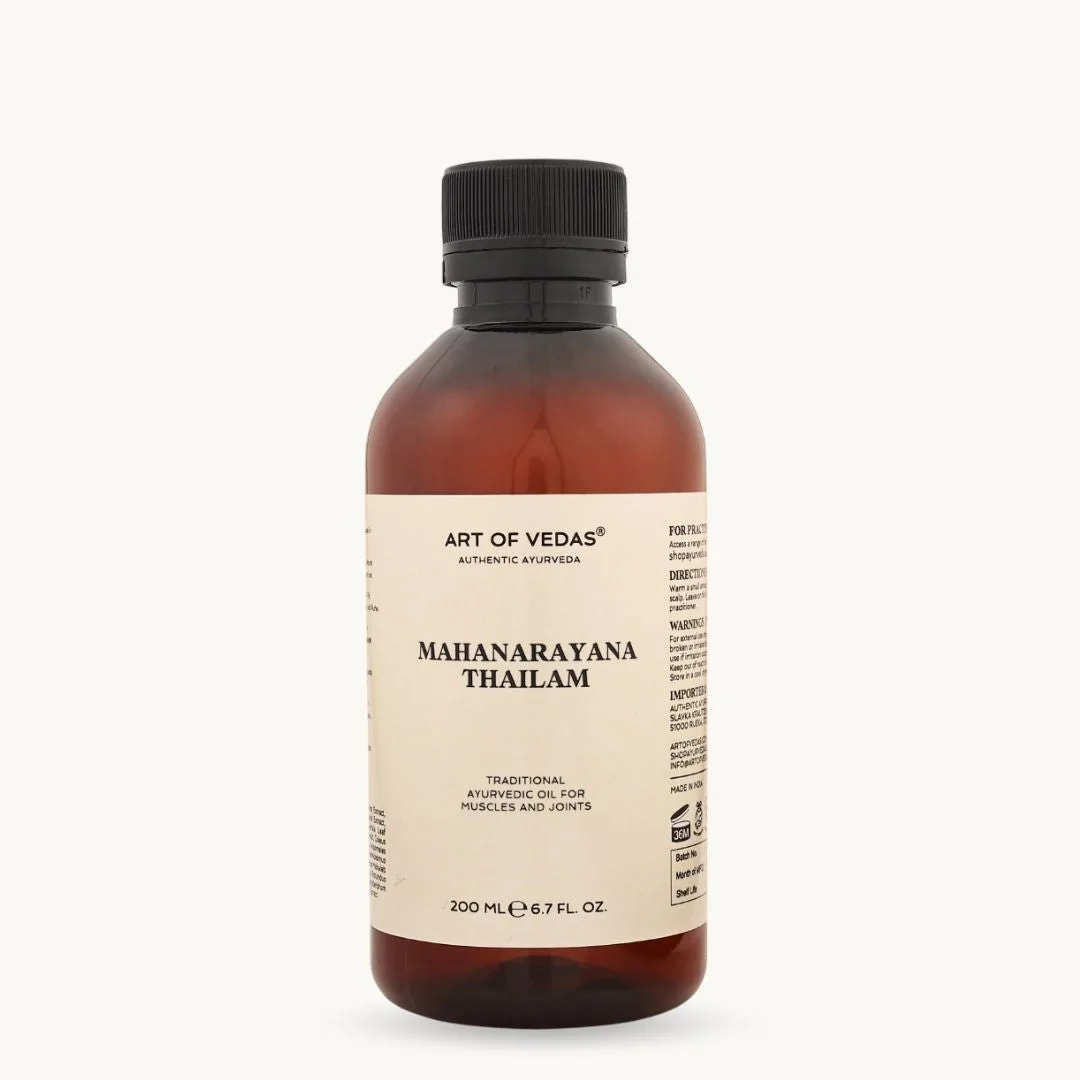
In brief: Mahanarayana Thailam is a classical Ayurvedic massage oil in a sesame oil base. The Art of Vedas oil declares 35 plant ingredients, among them roots of the Dashamoola group, Ashwagandha, Bala, Shatavari and warming spices such as cinnamon, cardamom and deodar. This page lists every declared ingredient, grouped by what it is, with its Sanskrit and botanical name.
The declared ingredient list of Art of Vedas Mahanarayana Thailam
The list below is the ingredient declaration of the Art of Vedas Mahanarayana Thailam, as printed on the product page. It names the plant, the part used and the botanical name. Mahanarayana Thailam is also written Mahanarayan oil, Mahanarayana Taila, Mahanarayan Tel or Maha Narayana Thailam; the spelling changes, the formula does not.
Base and finishing ingredients
- Sesame seed oil (Tila Taila, Sesamum indicum): the oil base in which all the plants are cooked
- Shellac (Laksha): a resin that the classical recipe adds to the cooking oil
- Rock salt (Saindhava, declared as Sodium Chloride)
- Camphor (Karpura, Cinnamomum camphora): added at the end for its aroma
Roots of the Dashamoola group
Dashamoola means ten roots. It is the group of tree and shrub roots that opens most classical Vata formulas, and several of its members are declared in this oil:
- Bilva, bael (Aegle marmelos), root bark
- Shyonaka, Indian trumpet tree (Oroxylum indicum), root bark
- Patala (Stereospermum colais), root bark
- Agnimantha (Premna corymbosa), root bark
- Brihati, Indian nightshade (Solanum indicum), root
- Kantakari, yellow-berried nightshade (Solanum xanthocarpum), whole plant
- Shalaparni (Desmodium gangeticum), root
- Salaparni (Pseudarthria viscida), root
- Gokshura (Tribulus terrestris), fruit
Our Dashmoola guide explains the ten roots one by one.
Strengthening and nourishing roots
- Ashwagandha (Withania somnifera), root
- Bala, country mallow (Sida cordifolia), root
- Atibala, Indian mallow (Abutilon indicum), root
- Punarnava (Boerhavia diffusa), root
- Shatavari (Asparagus racemosus), root
- Vidari (Ipomoea mauritiana), root
- Black musli (Curculigo orchioides), root
- Yashtimadhu, liquorice (Glycyrrhiza glabra), root
- Mudgaparni (Vigna pilosa) and mung bean (Vigna radiata), seed
Bark, flowers and leaves
- Paribhadra, Indian coral tree (Erythrina variegata), bark
- Prasarini (Paederia foetida), whole plant
- Nagakesara (Mesua ferrea), flower
- Palasha, flame of the forest (Butea monosperma), flower
- Manjishtha (Rubia cordifolia), root
- Haridra, turmeric (Curcuma longa), root
- Shaileyam, stone flower (Parmelia perlata), thallus
Warming spices and aromatics
- Twak, cinnamon (Cinnamomum verum), bark
- Tamalapatra, Indian bay leaf (Cinnamomum tamala), leaf
- Ela, cardamom (Elettaria cardamomum), seed
- Devadaru, deodar cedar (Cedrus deodara), wood
- Rasna, galangal (Alpinia galanga), root
- Shatapushpa, fennel (Foeniculum vulgare), fruit
- Musta, nutgrass (Cyperus rotundus), root
- Hrivera (Coleus vettiveroides), root
Naturally present fragrance components
Cinnamal, eugenol, linalool, coumarin, benzyl benzoate and limonene are declared at the end of the list. They are not added fragrances. They occur naturally in cinnamon, cardamom, bay leaf and the other aromatic plants, and EU cosmetics rules require them to be named once they pass a set concentration, so that people who react to them can see it.
How the ingredients go into the oil
A Thailam is not a mixture of oil and powder. In the classical method, called Sneha Paka, the tougher roots are first simmered into a decoction, the softer plants are ground to a paste, and both are cooked slowly into the sesame oil until the water has gone and the paste meets the traditional finishing tests. Camphor is stirred in only after the oil has come off the heat, so its aroma is kept. The full method is described in our Mahanarayana Thailam guide.
Because every plant is cooked into the base, the finished oil has one character rather than the separate characters of forty plants. In Ayurvedic terms it is described as warming and heavy and is classically placed with Vata. That is also why the same oil is never reproduced by adding a few drops of essential oil to plain sesame oil.
Classical recipe and declared list: why the numbers differ
Sources such as the Bhaishajya Ratnavali and the Sahasrayogam set out Mahanarayana Thailam with more than fifty ingredients, including goat milk and several rare Himalayan herbs. A product sold in Europe declares what is actually in the bottle, and some classical items are left out today for reasons of availability or of regulation. The declared list above is therefore the reference for the Art of Vedas oil, and a shorter list than the classical text is not a sign of a lesser oil. When you compare oils from different makers, compare their declared lists rather than their claims about how many herbs they contain.
Frequently asked questions about the ingredients
How many ingredients does Mahanarayana Thailam contain? The Art of Vedas oil declares 35 plant ingredients in a sesame oil base, plus shellac, rock salt and camphor. The classical texts list more than fifty, several of which are no longer used in a product sold in Europe.
What is the base oil of Mahanarayana Thailam? Sesame seed oil (Tila Taila). All the plants are cooked into it by the classical Sneha Paka method; no other carrier oil is declared.
Is Mahanarayana Thailam vegan? No. Shellac, a resin of insect origin that the classical recipe adds to the cooking oil, is on the declared list. All other declared ingredients are plant materials or mineral salt.
Does Mahanarayana Thailam contain nuts or sesame? It contains sesame: sesame seed oil is the base. No tree nuts or peanut are declared. Anyone who reacts to sesame should not use it.
Why are cinnamal, eugenol, linalool and coumarin on the label? They occur naturally in cinnamon, bay leaf, cardamom and the other aromatic plants in the oil. EU rules require them to be named above a set concentration so that sensitive people can check for them. They are not added perfume.
Does the Art of Vedas oil contain the Ashtavarga herbs or musk named in the old texts? No. The declared list above is complete for our oil. Several rare or animal-derived items of the classical recipe are not used in a product sold in Europe.
Which ingredient gives the oil its warming character? No single one. The warming quality comes from the whole formula cooked into sesame oil, with the spices (cinnamon, cardamom, deodar, galangal) and the Vata roots (Ashwagandha, Bala, the Dashamoola group) in the lead.
Where can I check the exact list before buying? On the product page, which carries the same declaration as the label, and on the label of the bottle. If you have a known sensitivity, show the list to your doctor or pharmacist first, and do a small skin test on the inner forearm before the first full application.
Read further