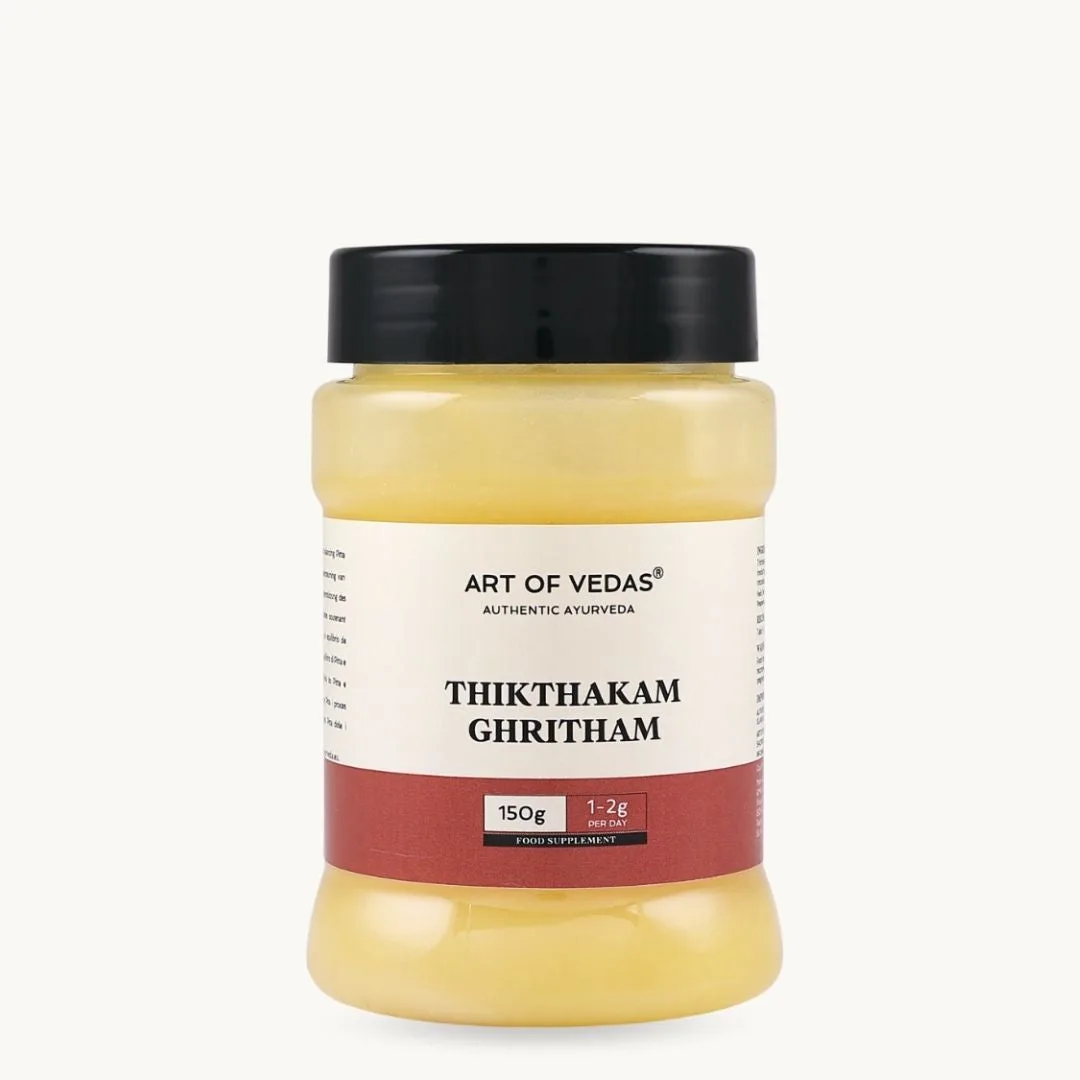
Thikthakam Ghritham is a classical bitter medicated ghee from the Tikta Ghritham (bitter ghee) family - one of the most important categories in classical Ayurvedic therapeutics for Pitta and Rakta Dhatu (blood tissue) management. The name states its composition directly: Tikta (bitter) and Ghritham (medicated ghee). Where Mahathiktakam Ghritham is the larger, more comprehensive bitter ghee formula with a broader herb group, Thikthakam Ghritham is a more focused preparation - a targeted bitter ghee that concentrates the core Tikta action on a smaller, precisely selected group of herbs.
The Tikta Ghritham family holds a consistent and prominent position in the classical texts. The Ashtanga Hridayam describes bitter ghee preparations as the primary internal approach to conditions involving Pitta aggravation in the blood, skin and inflammatory channels - the Raktavaha Srotas (blood channels), Swedavaha Srotas (sweat channels) and Bhrajaka Pitta (the skin Pitta sub-type). The combination of bitter herbs' Pitta-reducing, Ama-clearing channel-opening action with ghee's deep tissue penetration creates a preparation that reaches the Rakta Dhatu from within in a way that water-based or dry herb preparations cannot.
The full Thikthakam Ghritham product is available in the Art of Vedas Ghritham collection. The foundational context for all Ghritham preparations is in the Ghritham overview guide.
The Tikta Rasa: Why Bitter Herbs for Pitta and Rakta
Understanding Thikthakam Ghritham requires understanding the classical Ayurvedic pharmacology of Tikta (bitter) rasa - the taste that the Charaka Samhita and Ashtanga Hridayam consistently associate with Pitta reduction, Rakta Dhatu purification and Ama (toxic accumulation) clearing.
The classical texts describe Tikta rasa with a specific set of pharmacological properties that make it the primary taste for addressing Pitta-Rakta presentations:
Pitta Hara (Pitta-reducing): Tikta rasa directly cools and reduces the sharp, hot, spreading qualities of aggravated Pitta. Where sweet (Madhura) and cooling (Sheeta) herbs nourish depleted Pitta channels, bitter herbs actively reduce excess Pitta accumulation - making Tikta herbs the first choice for Pitta excess presentations rather than Pitta depletion.
Rakta Prasadana (blood tissue clarifying): The classical texts consistently describe bitter herbs as having specific affinity for the Raktavaha Srotas - the blood channels. Tikta rasa helps clear excess Pitta that has entered the blood channels and settles there to produce inflammatory Rakta Dhatu conditions. This blood-channel specificity is central to understanding why Thikthakam Ghritham is prescribed across a range of skin and inflammatory presentations in the classical literature.
Ama Pachana: Tikta rasa stimulates Agni (digestive fire) and helps clear Ama - the incompletely processed metabolic residue that accumulates when Agni is weakened. In Pitta presentations, this Ama often has a hot, sharp quality that lodges in the blood and lymphatic channels; bitter herbs clear it by stimulating the Agni needed to process it.
Srotoshodhana (channel clearing): Bitter herbs open blocked channels - the combination of Pitta reduction and Ama clearing together restores normal flow through the Srotas that excess Pitta and hot Ama have obstructed.
Classical Composition of Thikthakam Ghritham
Thikthakam Ghritham's herb group is centred on a focused selection of the most important classical Tikta herbs, each contributing a specific dimension of the overall Pitta-Rakta action:
Nimba (Azadirachta indica, Neem): The most widely referenced Tikta herb in classical Ayurveda. Nimba carries Tikta and Kashaya rasa, Sheeta Virya - a cooling bitter with strong affinity for the skin channels and Rakta Dhatu. Its classical Twak Vikara Nashana (skin condition-clearing) property makes it central to any Tikta preparation targeted at skin channel presentations.
Guduchi (Tinospora cordifolia): The "divine nectar" herb - one of the most important Tridoshahara (balancing for all three Doshas) herbs in the classical tradition, with particular strength in Pitta reduction and immune channel support. Guduchi carries Tikta and Kashaya rasa, Ushna Virya (warming - unusual in a Pitta-reducing herb, reflecting its specifically Tridoshic rather than purely Pitta-addressing character), and Madhura Vipaka. Its Rasayana status makes it a key tissue-nourishing component that prevents the excessive depleting action that pure bitter herbs can sometimes produce.
Patola (Trichosanthes dioica): The pointed gourd, whose leaves and roots carry strong Tikta and Kashaya rasa with Laghu (light) and Ruksha (dry) Gunas. Patola is a primary herb for Rakta Pitta presentations - conditions where Pitta has specifically entered the blood channels to produce sharp inflammatory patterns. In Thikthakam Ghritham, Patola contributes the Rakta-channel-clearing dimension.
Triphala (Amalaki, Bibhitaki, Haritaki): The three-fruit classic appears here not in its primary Tridoshahara digestive capacity but for its contribution of Kashaya rasa (astringency) and Amalaki's specifically Pitta-cooling and Rakta-nourishing action. Triphala in the bitter ghee context helps the preparation move through the digestive and blood channels while providing a secondary nourishing counterbalance to the predominantly reducing Tikta herbs.
Classical Indications
The Ashtanga Hridayam describes Thikthakam Ghritham across Pitta and Rakta Dhatu presentations. These are described in classical Ayurvedic terms for educational purposes:
Kushtha (skin channel conditions): The classical category that encompasses conditions of the skin and lymphatic channels arising from Pitta-Rakta imbalance. The classical texts describe Tikta Ghritham as one of the primary internal preparations for this category - working from within the blood channels to address the root Pitta-Rakta dynamic that manifests at the skin surface. Thikthakam Ghritham's focused bitter ghee action reaches the Rakta Dhatu through the internal route in a way that topical preparations cannot.
Rakta Pitta (Pitta in the blood channels): The classical condition of Pitta entering and aggravating the Raktavaha Srotas - producing sharp, hot inflammatory patterns in the blood and the tissues it nourishes. Thikthakam Ghritham directly addresses this pattern through the Tikta rasa's Rakta Prasadana action and ghee's penetrating carrier quality.
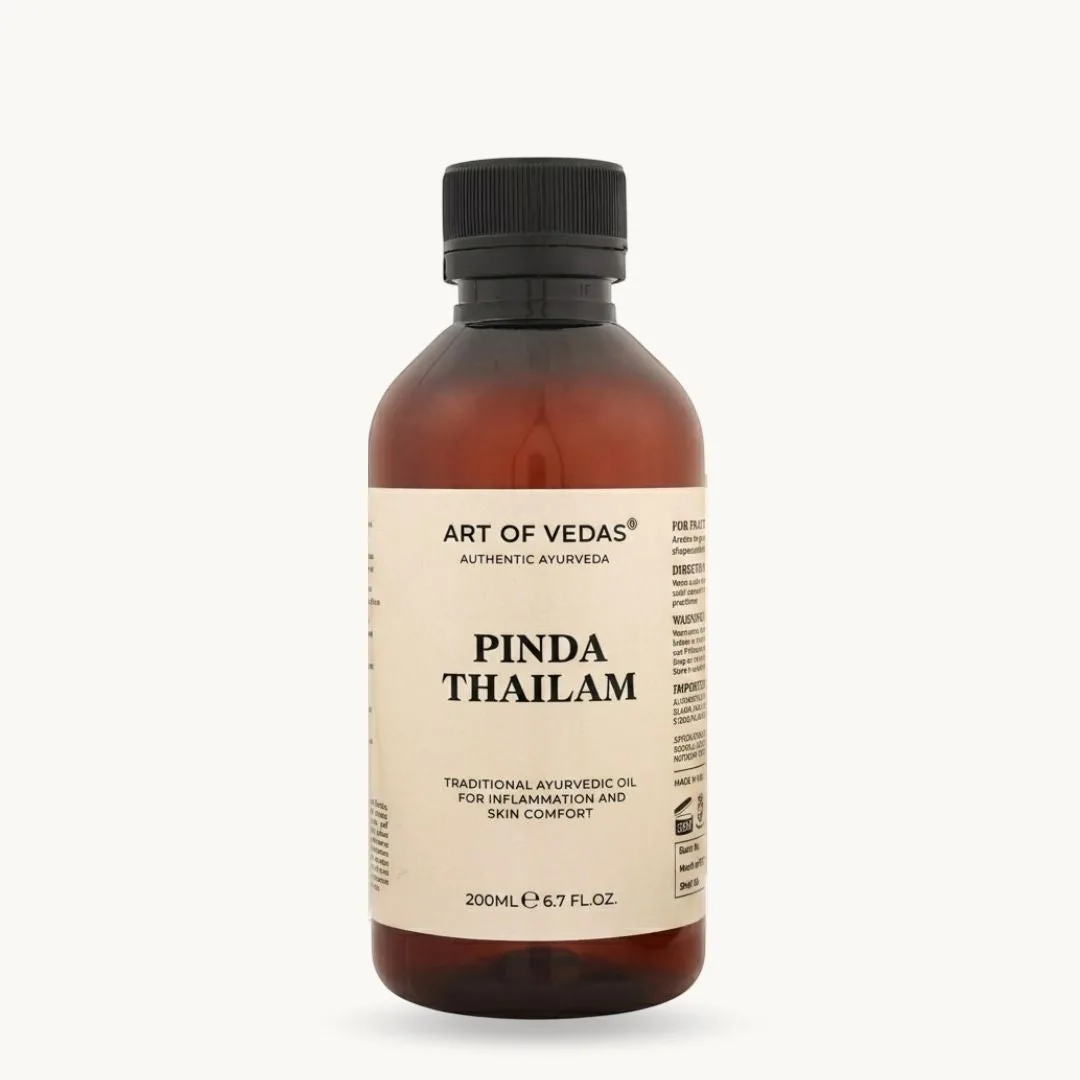
Vatarakta (Vata-Pitta joint condition): The classical joint channel condition arising from the combined disturbance of Vata and Pitta in the joint and blood channels - producing sharp, hot, inflammatory joint presentations. The Pinda Thailam addresses this externally through Abhyanga; Thikthakam Ghritham provides the internal Pitta-Rakta clearing dimension. The broader Pitta imbalance framework is in the Pitta imbalance guide.
Prameha (urinary channel conditions with metabolic dimension): The classical texts also describe Tikta Ghritham for conditions involving the urinary channels and metabolic channels where Pitta and Kapha have created Ama accumulation affecting the Mutra Vaha Srotas (urinary channels) and Medovaha Srotas (fat tissue channels). This reflects the broad Ama-clearing and channel-opening capacity of the Tikta preparation.
Thikthakam Versus Mahathiktakam: Understanding the Difference
Thikthakam Ghritham and Mahathiktakam Ghritham are both classical Tikta Ghritham preparations - but they differ in scope. Thikthakam uses a smaller, more targeted herb group concentrated on the core Tikta action. Mahathiktakam - the "great bitter ghee" (Maha = great) - uses a larger, more comprehensive herb group that extends the bitter action to a broader range of channels and Dhatu layers.
As a practical framework: Thikthakam Ghritham is most appropriate when the Pitta-Rakta presentation is relatively focused - primarily skin channel or blood channel Pitta - and a concentrated, targeted bitter ghee action is needed. Mahathiktakam Ghritham is most appropriate when the Pitta-Rakta presentation is broader - involving multiple channels, deeper Dhatu layers, or more complex mixed presentations. The dedicated Mahathiktakam Ghritham guide covers the fuller formula in detail. If uncertain, a qualified Ayurvedic practitioner can advise on which preparation is most appropriate.
How to Use
Take half a teaspoon of Thikthakam Ghritham on an empty stomach in the morning, warmed to liquid and taken with warm water. Begin with a small amount and build gradually. Thikthakam Ghritham's strongly bitter taste is more pronounced than the Vata ghees - the bitter quality is pharmacologically active and should be experienced directly rather than masked where possible.
Thikthakam Ghritham is most naturally complemented by a cooling, Pitta-managing Abhyanga practice - applying Pitta Dosha Massage Oil or Pinda Thailam externally alongside the internal Ghritham practice provides simultaneous internal and external Pitta-Rakta management. The Pitta imbalance guide and the Ritucharya guide provide the full seasonal context.
Frequently Asked Questions
Is Thikthakam Ghritham suitable for Vata constitutions?
The Tikta Ghritham family is primarily indicated for Pitta and Pitta-Kapha presentations. For pure Vata constitutions, the Ruksha (dry) and Laghu (light) qualities of bitter herbs can potentially aggravate Vata if used in large quantities over long periods. In ghee form, this risk is significantly reduced - the ghee base provides Snigdha (unctuous) and Guru (heavy) counterbalancing qualities. For Vata-Pitta mixed constitutions, Thikthakam Ghritham can be used carefully, with attention to any signs of increased Vata dryness. The Dosha assessment guide helps identify the primary constitutional pattern.
How long should I use Thikthakam Ghritham?
The classical texts describe Tikta Ghritham for sustained use in the context of the conditions it addresses - it is not a single-course preparation. For daily Rasayana use, the seasonal Pitta accumulation cycle described in the Ritucharya guide provides the natural framework: the summer-to-autumn period of Pitta accumulation and aggravation is the most natural time for sustained Tikta Ghritham use, with reduced frequency in the winter when Vata management becomes the primary focus.
Can Thikthakam Ghritham be used alongside Brahmi Ghritham?
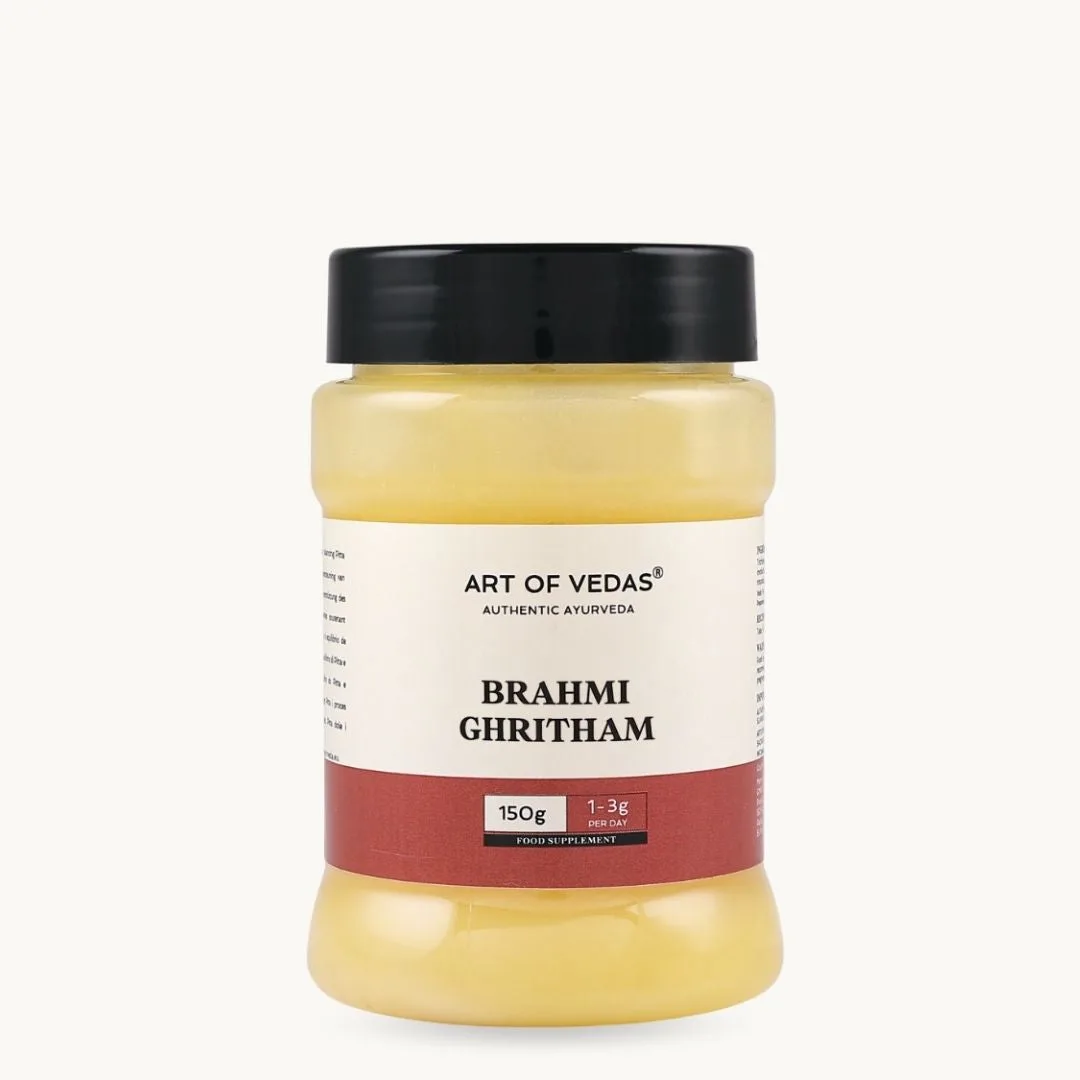
Both address Pitta presentations - Brahmi Ghritham specifically for the mental-cognitive Pitta dimension, Thikthakam Ghritham for the Rakta-channel and skin channel Pitta dimension. For complex Pitta presentations involving both mental heat and Rakta-channel involvement, using both together under qualified practitioner guidance is described in the classical Panchakarma context. For simpler home Rasayana practice, selecting the one most aligned with the primary presentation is the clearer approach.
This guide presents classical Ayurvedic concepts about Thikthakam Ghritham for educational purposes. Thikthakam Ghritham is a food supplement for daily Rasayana use and is not intended to diagnose, treat, cure or prevent any disease. Contains dairy (purified ghee). Consult a qualified Ayurvedic practitioner before use during pregnancy or if taking medications.