Sudhabala Thailam

(2)

Gentle Classical Oil for Strength, Nervous System Support & Daily Wellness

Rs. 2,100.00

Sudhabala Thailam is one of Ayurveda's gentlest yet most effective therapeutic oils, referenced in the classical text Sahasrayogam. This beautifully pure formulation features Bala (Sida cordifolia), the renowned "strength-giving" herb, prepared in a nourishing sesame oil base.

The name reveals its essence: Sudha means "pure" or "gentle," while Bala means "strength." This elegant two-ingredient formula delivers the profound benefits of Bala in its purest form, mild enough for daily use by nearly everyone, including during pregnancy and the postpartum period. Traditionally valued for supporting the nervous system, promoting muscle strength and addressing general weakness, Sudhabala Thailam embodies the Ayurvedic principle that the simplest formulations are often the most powerful.

Net Content

INGREDIENTS


Sida Cordifolia, Sesamum Indicum Oil.

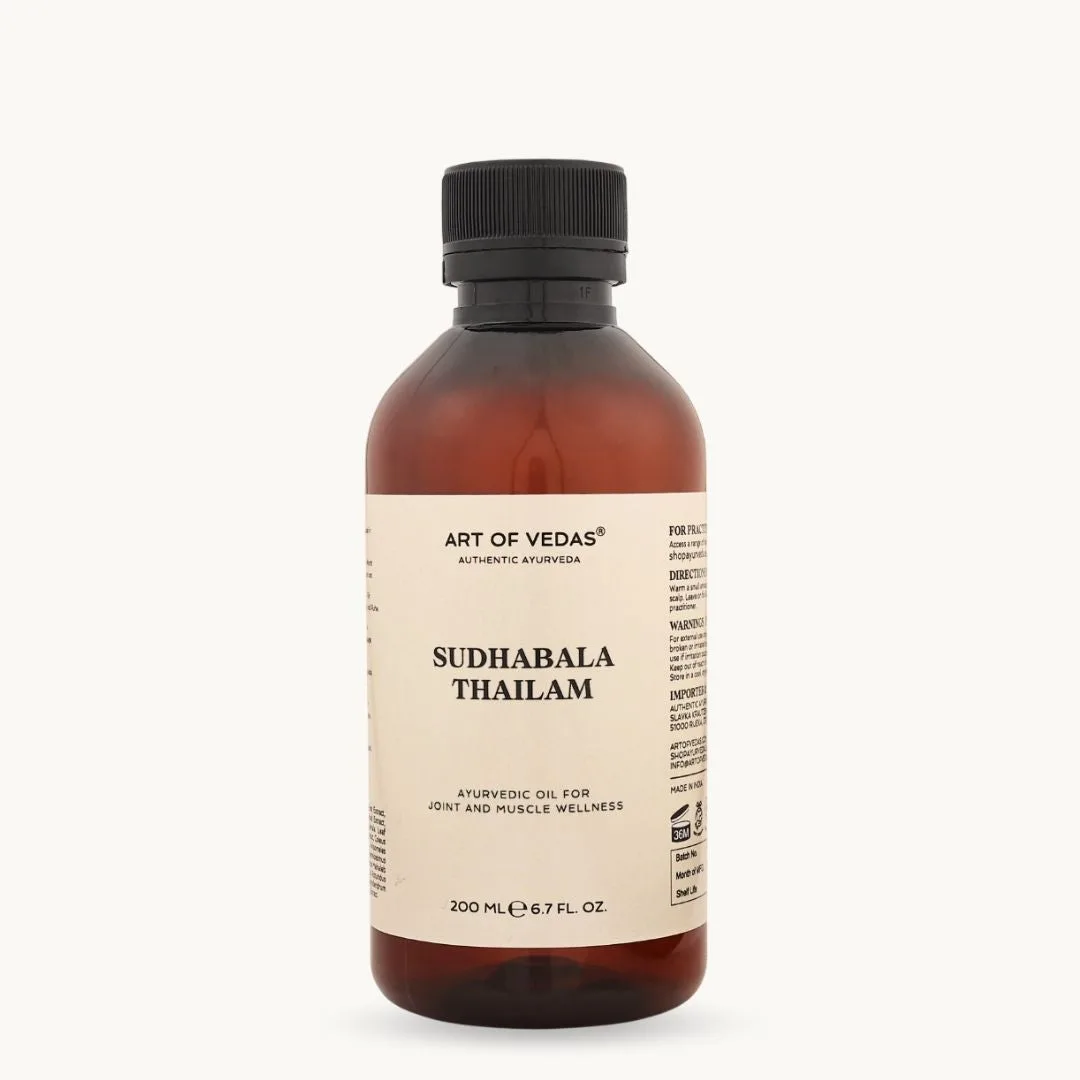
Bottle of Art of Vedas Sudhabala Thailam on a white background

Rs. 2,100.00

Rs. 2,100.00

Sudhabala Thailam - Art of Vedas

Why Use Sudhabala Thailam?

In a world of complex multi-herb formulations, Sudhabala Thailam stands apart through its elegant simplicity. With just two carefully chosen ingredients—Bala and sesame oil—this classical preparation demonstrates the Ayurvedic wisdom that masterful formulation is not about adding more, but about selecting exactly what is needed.

Referenced in the Sahasrayogam, one of Ayurveda's most respected classical texts, Sudhabala Thailam has been valued for centuries as both a therapeutic oil for specific concerns and a gentle tonic for everyday wellness. Its purity makes it one of the most versatile oils in the Ayurvedic tradition.

Bala: The Strength-Giving Herb

At the heart of Sudhabala Thailam is Bala (Sida cordifolia), whose very name means "strength" in Sanskrit. This remarkable herb is considered one of Ayurveda's most important Rasayana (rejuvenative) plants, specifically renowned for its effects on the muscular and nervous systems.

Bala is classified in classical texts as:

  • Balya - That which imparts strength
  • Brimhana - That which nourishes and builds
  • Rasayana - That which rejuvenates
  • Vata Shamaka - That which pacifies Vata
  • Medhya - That which supports mental clarity

The Charaka Samhita, one of Ayurveda's foundational texts, praises Bala as a prime remedy for Vata disorders and lists it among the Balya (strength-promoting) group of herbs. The Sushruta Samhita highlights its role in musculoskeletal strength and tissue nourishment. For centuries, traditional Indian wrestlers (pehelwans) have used Bala preparations to support their physical training—a practice that continues to this day.

What makes Bala particularly special is its gentle yet profound action. Unlike more heating or stimulating herbs, Bala has a cooling potency (Sheeta Virya) and sweet taste (Madhura Rasa), making it nourishing rather than depleting. This allows it to build strength over time without creating imbalance—ideal for long-term use.

The Premier Nervine Tonic

Bala is traditionally regarded as one of Ayurveda's finest nervine tonics. Classical texts specifically recommend Bala-based preparations for supporting the nervous system, addressing weakness and promoting healthy nerve function.

In Ayurvedic understanding, the nervous system is governed primarily by Vata dosha. When Vata becomes imbalanced, it can manifest as weakness, fatigue, restlessness or diminished vitality. Bala's profound Vata-pacifying properties, combined with its deeply nourishing nature, make it the herb of choice for nervous system support.

Sudhabala Thailam concentrates these benefits in an easily absorbable oil form, allowing Bala's therapeutic properties to penetrate deeply into the tissues where they are most needed. The oil format enhances bioavailability and enables direct application to areas requiring support.

Sesame Oil: The Perfect Carrier

Sesame oil (Tila Taila) serves as the foundation of Sudhabala Thailam, and its selection is far from arbitrary. In Ayurveda, sesame oil is considered the king of oils for Vata disorders due to its warming, penetrating and deeply nourishing properties.

The synergy between Bala and sesame oil is remarkable:

  • Sesame's warming quality balances Bala's cooling nature
  • Both are deeply nourishing to tissues
  • Sesame carries Bala's constituents deep into the body
  • Together they create comprehensive Vata pacification
  • The combination supports both muscles and nerves

Sesame oil contributes its own therapeutic properties, including natural antioxidants, essential fatty acids and skin-nourishing compounds. It has been used in Ayurvedic oil preparations for thousands of years precisely because of its superior ability to extract and deliver herbal benefits.

Traditional Uses

Sudhabala Thailam has been traditionally used in Ayurveda for:

  • Supporting nervous system function and balance
  • Promoting muscle strength and tone
  • Addressing general weakness and fatigue
  • Post-illness recovery and convalescence
  • Pregnancy and postpartum support
  • Gentle daily Abhyanga for overall wellness
  • Preventive care for maintaining vitality
  • Supporting healthy development in children
  • Calming Vata-related restlessness
  • Nourishing depleted tissues

The Gentlest Therapeutic Oil

What distinguishes Sudhabala Thailam from other therapeutic oils is its exceptional gentleness combined with genuine efficacy. While oils like Mahanarayana or Dhanwantharam Thailam contain dozens of herbs and are designed for specific therapeutic applications, Sudhabala offers a milder approach suitable for:

  • Those new to Ayurvedic oil massage
  • Individuals with sensitive constitutions
  • Pregnant and postpartum women (with appropriate guidance)
  • Children (under adult supervision)
  • Long-term daily use without concern of imbalance
  • Those seeking a pure, uncomplicated wellness oil
  • Anyone wanting the benefits of Bala in its simplest form

Who Benefits Most

Sudhabala Thailam may be particularly suitable for:

  • Those experiencing general weakness or low energy
  • Individuals seeking nervous system support
  • Pregnant women looking for a gentle massage oil (consult your healthcare provider)
  • New mothers during the postpartum recovery period
  • Anyone recovering from illness or physical depletion
  • Those with predominantly Vata constitution
  • People seeking a gentle oil for regular Abhyanga practice
  • Those who prefer simple, traditional formulations
  • Anyone wanting to build strength gradually and safely
  • Elderly individuals seeking gentle nourishment

How to use Sudhabala Thailam

Warming the Oil

Always warm Sudhabala Thailam before application. Place the required amount in a small bowl and warm gently using a water bath (placing the bowl in warm water) until the oil reaches a comfortable temperature. The oil should feel pleasantly warm but never hot.

Warming enhances absorption, improves the massage experience and aligns with traditional Ayurvedic principles of oil application.

Daily Abhyanga for General Wellness

Sudhabala Thailam is ideal for regular self-massage practice:

  1. Warm 20-30ml of oil
  2. Begin at the crown of the head (if including scalp massage) or shoulders
  3. Use long, flowing strokes on limbs (towards the heart)
  4. Use circular motions on joints
  5. Massage the abdomen gently in clockwise circles
  6. Pay particular attention to the feet, which have many nerve endings
  7. Complete the massage in 15-20 minutes
  8. Rest for 15-30 minutes to allow absorption
  9. Follow with a warm bath or shower

Local Application for Targeted Support

For focused application on specific areas:

  1. Warm 5-10ml of oil
  2. Apply to the area requiring attention
  3. Massage gently using circular motions
  4. Continue for 10-15 minutes
  5. Leave on for at least 30 minutes, or overnight for deeper support
  6. Cover with a soft cloth if leaving on overnight

For Nervous System Support

When using for nervous system wellness:

  1. Focus particularly on the head, neck and along the spine
  2. Gentle scalp massage (Shiro Abhyanga) is especially beneficial
  3. Include the soles of the feet—an important area in Ayurvedic practice
  4. Use slow, calming strokes with gentle pressure
  5. Consider evening application before rest for best results
  6. Maintain regular daily practice for cumulative benefits

For Pregnancy and Postpartum Care

Sudhabala Thailam is traditionally considered gentle enough for use during pregnancy and the postpartum period:

During Pregnancy:

  • Always consult your healthcare provider before use
  • Focus on limbs, avoiding deep abdominal massage
  • Use gentle pressure
  • Ideal for addressing tired legs and general fatigue

Postpartum:

  • Traditional practice recommends daily massage during recovery
  • Gentle full-body application supports restoration
  • Focus on areas of tension or fatigue
  • Morning application is traditionally preferred

Frequency of Use

For general wellness:
Daily use is traditional and appropriate for most people

For targeted support:
Daily application for 4-6 weeks, then assess benefits

For maintenance:
3-4 times per week as part of regular self-care

For building strength:
Consistent daily use over several weeks yields best results

Best Times for Application

Morning: Before bathing, to prepare the body for the day and support energy

Evening: Before bed, to support rest and overnight tissue nourishment

Traditional timing: 15-30 minutes before bathing allows optimal absorption

Important Guidelines

  • Perform a patch test before first use if you have sensitive skin
  • Always warm the oil before application
  • Avoid application on broken skin or open wounds
  • For use during pregnancy, always consult your healthcare provider first
  • Store in a cool, dry place away from direct sunlight
  • Keep out of reach of children
  • Use externally only

Classical Ayurveda Reference

Sudhabala Thailam is documented in the Sahasrayogam, a classical Ayurvedic text from the Kerala tradition containing thousands of traditional formulations. The text mentions this oil in the context of Vatavyadhi (Vata disorders) and conditions requiring strength-building support.

The formulation exemplifies the Ayurvedic principle of Ekamoolika—single-herb preparations where one powerful herb takes centre stage, allowing its full therapeutic potential to shine without dilution.

Sanskrit Name and Etymology

Sanskrit: शुद्धबल तैलम् (Śuddhābala Tailam)

The name combines:

  • Śuddha/Sudha (शुद्ध): Pure, clean, gentle, unadulterated
  • Bala (बल): Strength, power, vitality
  • Taila/Thailam (तैलम्): Medicated oil

The name thus means "Pure Strength Oil" or "Oil of Pure Bala," reflecting both its simple composition and its primary action of building strength through the purest form of this celebrated herb.

Classical Indications

In classical Ayurvedic texts, Sudhabala Thailam and Bala-based oils are indicated for:

  • Daurbalya - General weakness, debility
  • Vatavyadhi - General Vata disorders
  • Mamsa Kshaya - Muscle wasting or weakness
  • Sutika Paricharya - Postpartum care
  • Bala Roga - Children's conditions
  • Kshaya - Wasting, depletion conditions
  • Karshya - Emaciation
  • Shrama - Fatigue

Classification

Sudhabala Thailam is classified as:

  • Vatahara Thailam - Vata-pacifying oil
  • Balya - Strength-promoting
  • Brimhana - Nourishing, tissue-building
  • Rasayana - Rejuvenating
  • Jivaniya - Life-enhancing

Ayurvedic Pharmacology (Dravyaguna) of Bala

Understanding Bala's pharmacology explains why Sudhabala Thailam is both gentle and effective:

Rasa (Taste): Madhura (sweet) - Nourishing, tissue-building, pleasant

Guna (Qualities):

  • Guru (heavy) - Grounding, substantial
  • Snigdha (unctuous) - Moistening, lubricating
  • Picchila (mucilaginous) - Protective, soothing

Virya (Potency): Sheeta (cooling) - Calming, non-aggravating, suitable for long-term use

Vipaka (Post-digestive effect): Madhura (sweet) - Continues to nourish after absorption

Prabhava (Special action): Balya - Specific strength-promoting effect

Dosha Action:

  • Vata Shamaka (strongly pacifies Vata) - Primary action
  • Pitta Shamaka (pacifies Pitta) - Due to cooling nature
  • Mildly increases Kapha if used in excess - Due to heavy, sweet qualities

Karma (Actions)

  • Balya - Promotes strength and vitality
  • Brimhana - Nourishes and builds tissues
  • Vata Shamaka - Pacifies Vata dosha
  • Rasayana - Rejuvenates the body
  • Shukrala - Supports reproductive tissue
  • Ojovardhaka - Enhances vital essence (Ojas)
  • Hridya - Supports cardiac function
  • Stanyajanana - Supports lactation
  • Garbhasthapana - Traditionally supportive during pregnancy

Dhatu (Tissue) Affinity

Bala and Sudhabala Thailam have particular affinity for:

  • Mamsa Dhatu - Muscle tissue (primary)
  • Majja Dhatu - Nerve tissue and marrow
  • Shukra Dhatu - Reproductive tissue
  • Rasa Dhatu - Plasma and lymphatic tissue
  • Asthi Dhatu - Bone tissue (supportive)

The Concept of Balya Dravya

In Ayurveda, Balya Dravya refers to substances that promote Bala (strength). Sida cordifolia is considered the foremost among these herbs, literally embodying the quality in its name. The concept of Bala encompasses:

  • Physical strength of muscles and body structure
  • Nervous system strength and resilience
  • Immune strength (Vyadhikshamatva)
  • Mental and emotional fortitude
  • Vital energy and essence (Ojas)
  • Reproductive vitality

Frequently Asked Questions About Sudhabala Thailam

Sudhabala Thailam is a gentle classical Ayurvedic oil traditionally used to support the nervous system, promote muscle strength and address general weakness or fatigue. Its pure, two-ingredient formulation—featuring the celebrated strength-giving herb Bala in a sesame oil base—makes it exceptionally suitable for daily Abhyanga massage and long-term wellness use. It is particularly valued in traditional Ayurveda for postpartum recovery, convalescence after illness, and as a preventive tonic for maintaining nervous system health and overall vitality.

Sudhabala Thailam offers several traditional Ayurvedic benefits centred on its strength-building and nervous system supporting properties. The oil helps promote muscle strength and tone, supports healthy nerve function and nervous system balance, and addresses general weakness or fatigue. It is deeply nourishing to tissues, particularly muscle (Mamsa) and nerve (Majja) dhatus. The cooling, gentle nature of Bala makes this oil ideal for calming Vata-related restlessness and promoting a sense of groundedness. Regular use through Abhyanga massage also supports healthy circulation, skin nourishment and overall vitality. Its exceptional gentleness makes it suitable for long-term daily use, pregnancy and postpartum recovery, and for those with sensitive constitutions.

Yes, absolutely. Sudhabala Thailam is gentle enough for daily use and, in fact, regular daily application is the traditional approach. The oil's simple, pure composition and Bala's cooling, nourishing nature make it ideal for long-term use without creating imbalance. Daily application—typically in the morning before bathing—allows the cumulative benefits of Bala to build over time, progressively strengthening tissues and supporting the nervous system. Consistency is key to experiencing the full benefits of this classical formulation.

Store Sudhabala Thailam in a cool, dry place away from direct sunlight and heat sources. Keep the bottle tightly closed when not in use to preserve the oil's quality and prevent oxidation. Avoid storing in humid environments such as bathrooms. When stored properly, the oil maintains its therapeutic properties for the duration indicated on the packaging. Before each use, check that the oil has its characteristic colour and aroma. If you notice any significant changes in smell, colour or consistency, discontinue use. Keep out of reach of children.

Sudhabala Thailam primarily benefits Vata dosha. Bala is one of Ayurveda's foremost Vata-pacifying herbs, and its effects on the nervous system and muscles directly address Vata's domain. However, due to Bala's cooling potency (Sheeta Virya) and sweet taste (Madhura Rasa), this oil also calms Pitta and is generally well-tolerated by all constitution types. Those with very high Kapha or conditions of significant heaviness may wish to use in moderation, as Bala's heavy, nourishing qualities could increase Kapha if overused. For most people, however, Sudhabala Thailam is a gentle, balancing oil suitable regardless of constitution.

Sudhabala Thailam is traditionally considered one of Ayurveda's gentlest therapeutic oils and has been used during pregnancy and the postpartum period in traditional practice for centuries. Bala itself is classified as Garbhasthapana (supportive of pregnancy) in classical texts, and its cooling, nourishing nature is generally well-tolerated. However, every pregnancy is unique, and you should always consult your healthcare provider or qualified practitioner before using any herbal product during pregnancy. They can advise whether this oil is appropriate for your individual situation.